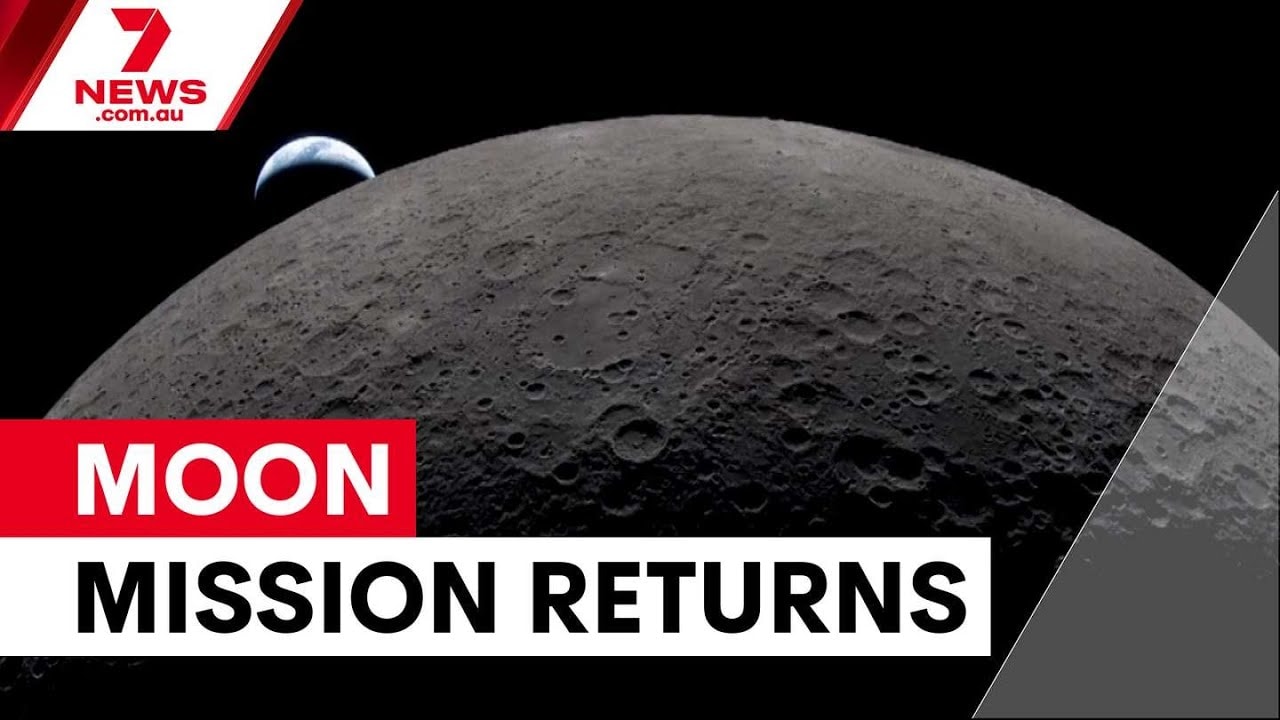

Artemis 2 is returning to Earth with historic lunar images, and NASA’s focus has shifted firmly to one goal: getting the four astronauts home safely. After their lunar flyby, the Orion spacecraft is now preparing for splashdown, while scientists begin analysing the photographs taken further into space than anyone has ever gone.
What makes this mission stand out isn’t only the distance achieved. It’s the rare, cinematic “postcards home” captured along the way—views of Earth framed against the Moon’s horizon, a solar eclipse unfolding in near-total darkness, and more glimpses that hint at what the Artemis programme could make possible next.
Orion’s journey home: splashdown preparations begin
With Artemis 2 now on its way back to Earth this afternoon, NASA has moved into the final stretch of a test flight that’s been historic from the start. The mission crew’s lunar flyby marked a major milestone for the Artemis programme, but the immediate priority is the same for every crewed mission: safety through careful landing operations.
As Orion heads home, NASA prepares for splashdown, the moment when the spacecraft returns to Earth and the astronauts can begin the next phase of mission debrief. For the crew, it’s a transition from photographing and observing to a quieter, more procedural stage—getting from deep space back to home and ensuring everything unfolds as planned.
Postcards home: Earth setting behind the Moon
Among the images shared from the journey are the kinds of visuals that remind people on Earth what “distance” actually looks like. The crew captured scenes where Earth shines above the lunar landscape as it appears to set behind the Moon’s horizon.
It’s not just beautiful—it’s also a reminder of perspective. The astronauts travelled far enough that familiar celestial movements play out dramatically, with the Moon acting as a foreground divider between what the crew sees and what remains hidden.

A total solar eclipse, seen from near space
Later in their voyage, the crew were treated to a solar eclipse—one of those moments that can be fleeting from Earth, but becomes strikingly detailed from space. The transcript describes a totality that lasted nearly an hour as the spacecraft passed through the eclipse conditions.
In that darkness, the sun is entirely blocked from view. The imagery of the bright Earth contrasted with the Moon hanging in front of the line of sight underscores how the geometry of space makes events look different—yet equally awe-inspiring.

When the Moon blocks more than light: radio blackout
Some of the most valuable moments aren’t always visible to the naked eye. At one point during the journey, the Moon blocks the radio signal—meaning that for about 40 minutes, the four astronauts were alone in the universe, cut off from direct communications.
Then, communications returned. The crew heard from Houston again, confirming that everything had continued as expected during a period when the spacecraft’s view of Earth and space was uninterrupted by radio contact.
This kind of comms interruption is more than a dramatic story beat. It’s a reminder that spaceflight decisions and mission timing are built around the realities of orbits, angles, and what can physically block signals.

Scientific value isn’t automatic—analysis is just beginning
Once the Orion spacecraft is on its way home, the attention naturally turns to what comes next: the assessment of scientific value. Colleagues on Earth begin to evaluate the photographs the crew has taken, and the process is described as a healthy, active scientific debate.
Even if you might expect image fatigue—after hundreds of images—the reaction from mission personnel is clear: there’s no “getting sick of it.” Instead, conversations focus on what can be extracted from specific conditions, particularly those during the eclipse period.
One debate centres on what is visible of the solar corona. Another centres on what can be seen of zodiacal light. These are the kinds of details that turn a stunning image into usable science—requiring researchers to interpret brightness, contrast, and atmospheric or instrument effects.

Why this mission matters: a test flight for Artemis
Artemis 2 is a test flight for the broader Artemis programme, which aims to build a permanent base on the Moon’s surface. The mission’s significance is therefore twofold: it demonstrates how humans can travel and operate in lunar space, and it gathers information that will influence how future missions are planned.
There is also a longer-term vision behind the programme—further exploration of the cosmos, and the possibility of missions that extend even beyond the Moon. The photographs and lessons learned from this test flight help shape what comes after.
The Moon’s south pole: another glimpse toward a permanent base
While the mission focused on the lunar flyby, it also captured another “tantalising glimpse” of where a future base could be built. The transcript points to a likely location near the Moon’s south pole.
That region has become central to Artemis planning, and the crew managed to take another snap on their way past. In practical terms, images like these help turn destination goals into something more measurable—supporting discussions about environment, terrain, and the kinds of landing and operations that could be required.

What happens next for the crew and the mission
As splashdown approaches, the crew’s immediate story is about returning safely. But back on Earth, the story continues in a different way: scientists and engineers are already assessing how the captured visuals can support upcoming Artemis objectives.
The eclipse-related imagery, in particular, is presented as the start of deeper learning rather than a finished product. The transcript frames the scientific debate as just beginning—because turning photographs into conclusions requires careful interpretation and cross-checking.
Key takeaways
- Artemis 2 is returning to Earth after a historic lunar flyby.
- NASA’s current focus is splashdown and getting the four astronauts home safely.
- The crew captured standout views of Earth setting behind the Moon and a solar eclipse with nearly an hour of totality.
- During the eclipse period, the Moon blocked the radio signal, leaving the astronauts without direct communication for about 40 minutes.
- Researchers are already analysing eclipse-period images for features including the solar corona and zodiacal light.
- The mission is a test flight for Artemis, which aims for a permanent lunar base, potentially near the south pole.
FAQ
What is NASA’s main priority right now for Artemis 2?
NASA’s main focus is getting the four astronauts home safely as the Orion spacecraft prepares for splashdown.What kinds of photographs did the Artemis 2 crew capture?
The crew captured images including Earth appearing to set behind the Moon’s horizon, a total solar eclipse lasting nearly an hour, and views connected to the Moon’s south pole, alongside many other images gathered during the journey.How long were the astronauts without radio contact?
The transcript describes a period of about 40 minutes when the Moon blocked the radio signal and the astronauts were without direct communications.What scientific topics are being debated from the eclipse images?
Mission personnel have highlighted debate about what can be seen of the solar corona and what can be seen of zodiacal light, based on images taken during the eclipse period.How does Artemis 2 connect to future lunar plans?
Artemis 2 is a test flight for the Artemis programme, which seeks to build a permanent Moon base—likely near the south pole—and support longer-term exploration goals.The information in this article has been adapted from mainstream news sources and video reports published on official channels. Watch the full video here Artemis 2 crew returns with historic lunar images | 7NEWS