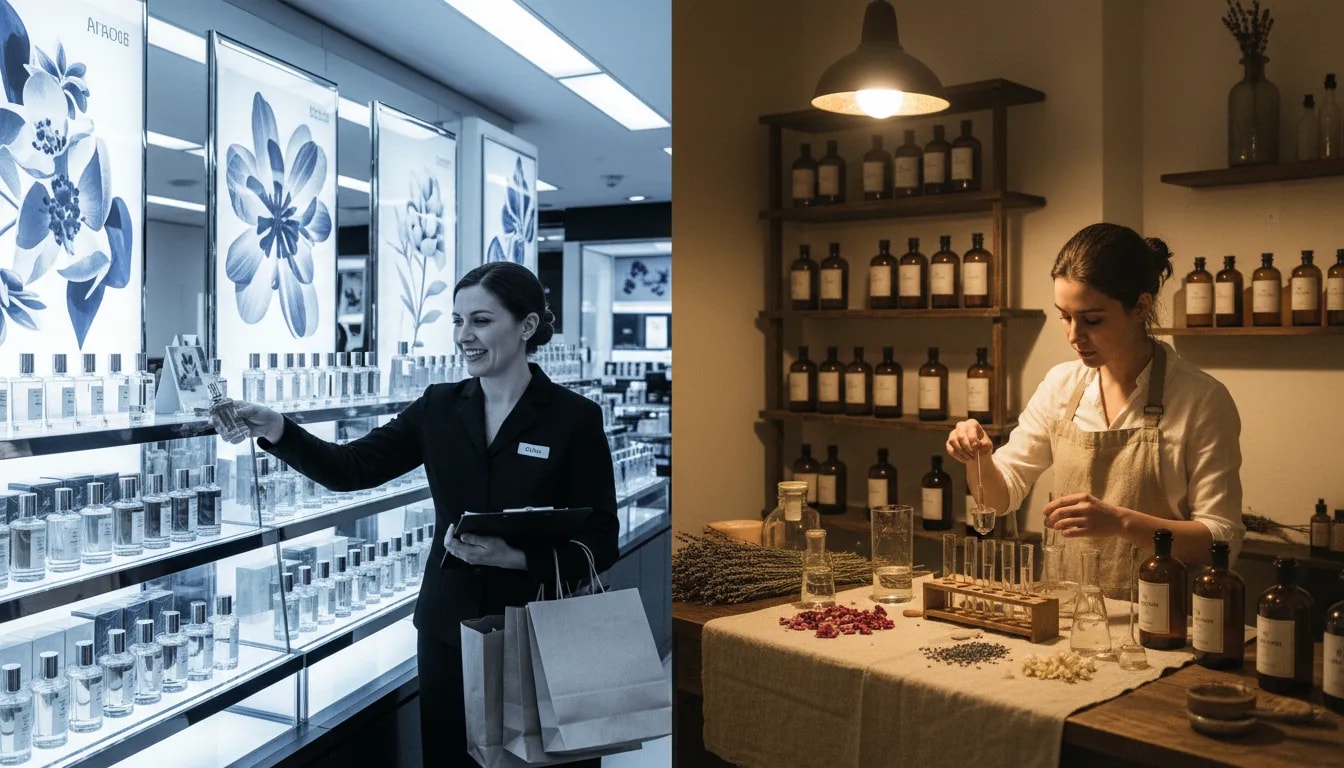
Walk into any department store perfume counter and you’ll encounter a very particular kind of experience. Overwhelming. Overlit. Staffed by people incentivised to sell you whatever’s being promoted that month. The fragrances themselves are, increasingly, formulated by committee — brand extensions of celebrity names, safe compositions designed to offend nobody and inspire nobody.
It wasn’t always like this. And for a growing segment of fragrance consumers, the department store counter is the last place they’d go to find something worth wearing.
The rise of niche and independent fragrance
The niche fragrance movement — led by houses like Maison Francis Kurkdjian, Frederic Malle, Byredo, and Le Labo — emerged as a direct response to the creative conservatism of mainstream perfumery. These brands gave perfumers creative control, used higher concentrations of quality raw materials, and priced accordingly. Consumers who discovered niche fragrance often describe it as a one-way door; it’s hard to go back to department store brands after you’ve experienced what’s possible.
But niche houses have their own problem: pricing. A 100ml bottle from Maison Francis Kurkdjian retails for $400 or more. Byredo and Le Labo sit in similar territory. For many consumers, the quality is desirable but the price is prohibitive.
The accessible alternative
This is where independent labels like Scent Room are carving out significant ground. Scent Room produces extrait de parfum — the highest concentration tier in perfumery, above both EDP and EDT — in formulations inspired by the major niche and designer houses. Baccarat Rouge 540, Oud Ispahan, Sauvage Elixir, Ombré Leather, Bleu de Chanel: the reference points are well-chosen, the execution is taken seriously, and the price point makes them genuinely accessible at Scent Room Australia.
The brand also produces a range of original compositions — Althaïr, Gris, Attrape Rêves, Fleur du Désert, Rouge Trafalgar — that stand independently of any designer reference. These are the expressions of genuine formulation ambition: perfumes developed for their own sake rather than as interpretations of something else.
What to look for in an independent fragrance
If you’re exploring independent fragrance for the first time, a few things are worth paying attention to. Concentration matters: extrait de parfum formulations tend to last longer on skin and evolve more interestingly over time than lighter concentrations. Transparency about ingredients and process is a good sign — brands that take formulation seriously tend to talk about it openly. And trust your nose over any marketing language; the only question that matters is whether you like how it smells on your skin.
The independent fragrance market in Australia is still relatively young compared to Europe and North America. But it’s growing quickly, and the quality available locally — without paying import prices — has never been better.