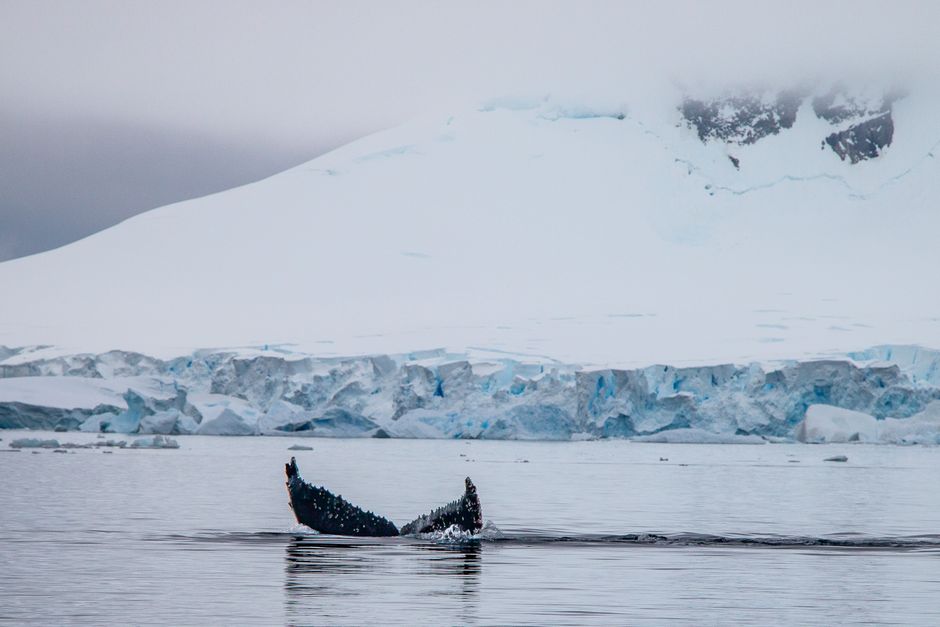
As summer fades from the Antarctic Peninsula each March, something remarkable happens: the wildlife does not retreat. It performs. Travellers willing to time their expedition cruises to the tail end of the southern summer are being rewarded with feeding frenzies, whale congregations and penguin colonies in full swing, all set against a backdrop of drifting blue icebergs and tinkling sea ice.
A Front-Row Seat to Bubble-Net Feeding in Antarctica
Few wildlife spectacles on the planet match what late-season visitors to Charlotte Bay, on the Antarctic Peninsula, can witness. In early March, humpback whales gather in Antarctic feeding grounds to gorge on krill before beginning their long migration north. The result, for those lucky enough to be in a Zodiac inflatable at water level, is extraordinary.
The behaviour on display goes well beyond the occasional tail slap or arching dive. The water can erupt without warning in a spiral of bubbles before a group of humpbacks surges upward together, their pleated throats stretched wide, drawing in vast quantities of krill in what is known as bubble-net feeding, a collective hunting technique in which whales use rising columns of bubbles to corral prey before lunging through the surface as one.
"It's not that there's more wildlife about," says the onboard zoologist travelling with one recent expedition. "But it's what the wildlife is doing that makes a late-season expedition so remarkable."
The same voyage through the Drake Passage and the South Shetland Islands produced black-browed albatross, storm petrels, chinstrap penguins nesting on collapsed volcanic cones, and Antarctic terns diving like silver arrows. Every day, it is reported, delivered encounters that felt almost too vivid to process.
Who Is Actually Visiting Antarctica, and What It Costs the Continent
Antarctica remains one of the least visited places on Earth, yet the numbers are growing. According to the International Association of Antarctic Tour Operators (IAATO), 112,412 people visited Antarctica during the 2025-2026 season, with just over 85,195 making actual landings on the continent.
To frame that figure: it is roughly equivalent to filling a large football stadium once. But expedition leaders working in the region are clear that even a crowd that modest leaves a mark on one of the world's most fragile environments.
"It's only when people see and experience Antarctica first-hand that they fully understand what is at stake," says one veteran expedition leader with 92 Antarctic voyages to her name, who also holds qualifications as a climatologist and senior polar guide.
IAATO enforces strict protocols governing the number of passengers permitted ashore at any one time, approved landing sites and biosecurity requirements. Those requirements have tightened in recent years due to the ongoing threat of avian influenza. Where visitors once sat on ice to let curious penguins approach them, today nothing but boots and the tips of walking poles may touch the ground. Every return to the ship now involves a meticulous boot wash and disinfection procedure.
The Expedition Team Behind the Experience
Responsible Antarctic tourism relies heavily on expert onboard staff. Some expedition vessels now carry teams of up to 28 specialists, including marine biologists, ecologists, geologists, historians, crevasse rescue specialists, kayak guides and ornithologists, all dedicated to both guest education and conservation awareness.
The ships themselves have also evolved. Vessels originally built in the mid-1990s have been progressively retrofitted and converted into purpose-built polar expedition ships, complete with modern stabilisers that make the notoriously rough Drake Passage crossing more manageable than it once was.
The consensus among those who have made the journey is consistent: the late Antarctic summer, particularly around March, is worth seeking out. The ice is working, the whales are feeding and the wildlife is not simply present. It is putting on a show.