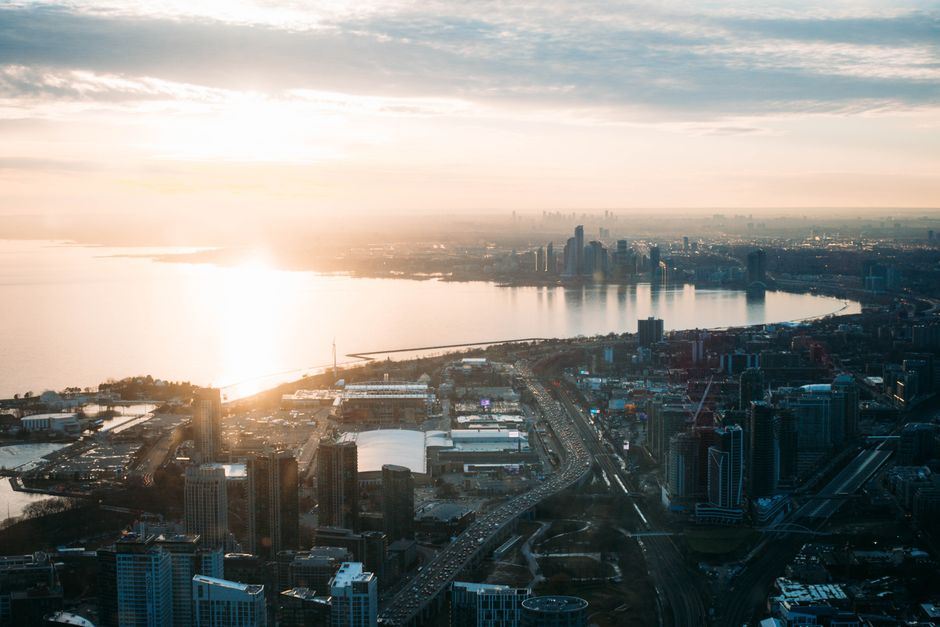
US President Donald Trump has signed an executive order renaming Lake Ontario as "Lake America", escalating an already bitter feud with Canada as a damaging trade war between the two neighbours takes hold. Trump announced the name change at the White House on Friday, telling reporters gathered in the Oval Office: "We're going to be changing the name of Lake Ontario effective immediately to Lake America."
The move drew swift condemnation from Canadian Prime Minister Mark Carney, and marks the latest flashpoint in a rapidly deteriorating relationship between two countries that share one of the world's most extensive trade partnerships.
What Trump Said — and the Maps Behind His Desk
As Trump signed the order, two maps of the US-Canada border were displayed behind his Oval Office desk — one showing the words "Lake America" printed in red over the lake, and another bearing the header "Making the Great Lakes Even Greater."
When asked why he was targeting an ally rather than an adversary, Trump was blunt: "The Canadian officials have treated us very badly. They're nasty people." He went further, describing Canada as the most difficult trading partner the United States faces. "People, oftentimes, they'll ask me who's the worst to deal with on trade? And I said that's easy. Canada. They are the worst to trade with," the 80-year-old Republican said.
Trump framed the renaming as part of a broader pattern, pointing to his earlier decision to rename the Gulf of Mexico as the Gulf of America — a change he made on his first day back in office in January 2025. "As you know, we took something called the Gulf of Mexico, we changed it, and now it's very routinely the Gulf of America," he said, adding that the Lake Ontario decision was "something I've been thinking about for a long time."
He also floated the possibility of renaming the Atlantic and Pacific Oceans. "So, if you think about it, we have a gulf and we have a lake. Now all we need is an ocean. So, maybe we'll have to change the name of the Atlantic and/or the Pacific. Maybe we'll change them both," Trump said.
Canada Pushes Back, Citing Indigenous Origins of Lake Ontario's Name
Prime Minister Carney rejected the renaming outright, noting that the name "Lake Ontario" has deep Indigenous roots. The name is derived from the Huron word "Ontari'io", meaning "great lake" or "beautiful water," according to the National Museum of the Great Lakes. The lake also shares its name with the Canadian province of Ontario, and Toronto — Canada's largest city — sits on its northwestern shore.
"We know that America is changing. Their trading relationships, their foreign policies, their national monuments, their hydronyms," Carney wrote on social media platform X. "Canadians also know that naming reality means calling it Lake Ontario — then, now and always."
Lake Ontario is a body of water shared by both nations, making Trump's unilateral renaming particularly provocative from Canada's perspective.
Trade War Backdrop Deepens the Dispute
The name change comes amid a serious breakdown in US-Canada trade relations. Talks between the two countries collapsed at the eleventh hour last week, with Trump's tariffs taking effect on Saturday. Canada responded with retaliatory tariffs on Wednesday, with Carney declaring: "You're at war when you get attacked. We got attacked."
Trump had first signalled the renaming earlier in the week, announcing he was giving it "serious consideration" before posting a TikTok video stating his intention to proceed. The executive order formalised that intent on Friday.
The Lake Ontario rebrand follows a now-established pattern of American expansionism under Donald Trump that has alarmed allies around the world. During his second term, Trump has pushed claims that Canada should become the 51st US state, laid claim to Greenland — an autonomous territory of NATO ally Denmark — and spoken of making Venezuela a US state. The Gulf of Mexico renaming, while now standard in US federal usage, has been rejected by Mexico and has not gained international recognition.
Whether the Lake Ontario name change will face similar international resistance remains to be seen, but Canada has made clear it has no intention of accepting it.