President Donald Trump has announced the United States will assume the role of permanent guardian of the Strait of Hormuz — and will charge a toll of 20 per cent of cargo value on every ship that passes through the waterway — as Washington simultaneously reinstates its naval blockade against vessels entering or leaving Iranian ports. The sweeping declarations, posted to Truth Social on Monday (Washington time), come as renewed military exchanges between the US and Iran threaten to unravel a diplomatic agreement struck only weeks ago.
The Toll Announcement and What It Means
"The Hormuz Strait is OPEN, and will remain OPEN, with or without Iran," Trump wrote, declaring the United States would henceforth be known as "THE GUARDIAN OF THE HORMUZ STRAIT." He framed the proposed toll as a matter of fairness, arguing the US had protected the waterway for decades without financial compensation. "We guarded it for nothing, and now we're going to guard it, and we're going to get paid for guarding it — a lot of money," Trump said in a television appearance earlier the same morning.
The toll proposal marks a sharp reversal of longstanding American policy, which has consistently held that passage through the strait must remain free and open to all nations. As recently as late June, Secretary of State Marco Rubio emphatically ruled out any such mechanism, saying: "The whole world will be against any mechanism that charges money to use an international waterway. It's that simple." Rubio added at the time that no country on the planet supported tolling the strait and that it simply was not going to happen.
Trump's announcement had an immediate, if moderate, effect on global energy markets, with Brent crude climbing toward US$80 a barrel in Monday morning trade.
Iran Blockade Reinstated as Ceasefire Collapses
Alongside the toll declaration, Trump confirmed the reimposition of the naval blockade targeting ships entering or departing Iranian ports. The lifting of that blockade had been a central pillar of the Memorandum of Understanding reached between Washington and Tehran in June — an agreement now under severe strain. For more background on the conflict's trajectory, see our earlier coverage of Trump, Iran, the ceasefire and the Strait of Hormuz.
The breakdown followed a series of aggressive moves by Iran's Islamic Revolutionary Guard Corps, which struck three commercial vessels in the strait. Trump declared the ceasefire "over" and ordered four successive waves of US military strikes hitting Iranian radar and surveillance infrastructure, air defence systems, drone launch sites and small naval vessels. A subsequent, even larger operation reportedly struck around 140 Iranian military targets on Sunday alone.
Iran retaliated by launching missile and drone attacks against US military assets in the Gulf, striking at forces based in Bahrain, Kuwait, Qatar, Jordan and Oman. The IRGC Navy also hit a Cyprus-flagged vessel with an anti-ship cruise missile and declared the strait "closed" — a claim the US Central Command (CENTCOM) has rejected, maintaining the waterway remains open to transit. Details of the US response are outlined in our report on US strikes after Tehran declared the strait closed.
The broader context of this rapidly escalating confrontation is documented as part of the 2026 Iran war.
Shipping Traffic at a Fraction of Normal Levels
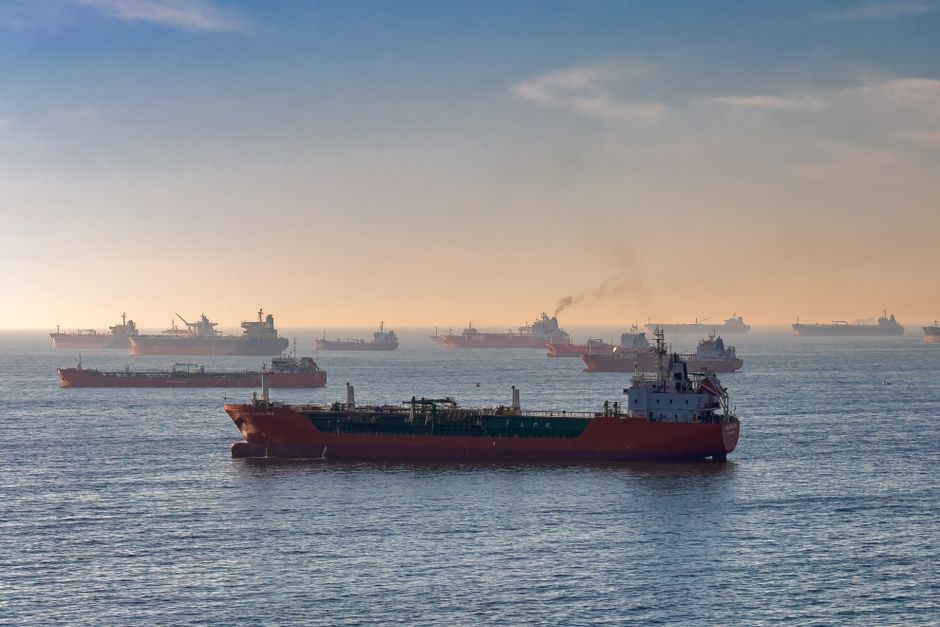
The human and commercial cost of the conflict is already visible in the near-collapse of maritime trade through the strait. Before hostilities erupted, roughly 110 vessels passed through the chokepoint each day on average. As of the weekend, open-source vessel tracking data showed only around 15 ships transiting the strait in a 24-hour period — a fraction of normal traffic, despite a brief surge during the US-Iran negotiation period last month. Of those 15 vessels, 11 entered the Persian Gulf — comprising six cargo ships and five tankers — with four additional cargo vessels crossing into the Gulf of Oman.
A US official confirmed the severely depressed transit figures, noting that more than 20 ships had passed through on Thursday, itself a low number by historical standards. The region has also been experiencing persistent GPS spoofing — navigational interference that causes vessels' broadcast positions to appear in incorrect locations — though the recent crossings do not appear to have been affected by spoofing.
Washington Expects Iran to Declare the Strait Open
Despite the military posturing, senior US officials say Washington is expecting Iran to publicly declare the Strait of Hormuz open and to commit to not attacking commercial vessels attempting to transit it. That statement is expected within days, following a meeting between Iranian Foreign Minister Abbas Araghchi and his Omani counterpart, Badr al-Busaidi.
Officials did not specify precise consequences if Iran fails to make such a declaration, though one warned it would "not be a great day for them." Notably, US officials described the IRGC attacks on merchant shipping as the work of an "errant part" of Iran's system — elements working to sabotage the Versailles memorandum — and said Iran itself acknowledged in communications with Washington that the strikes had been a mistake. "They came back to the table and said we screwed up," one official said.
Even so, that acknowledgement did not deter Trump from ordering retaliatory strikes. "President Trump didn't care. He basically said, if you hit us, we're going to respond 20 times," an official said. The White House believes a power struggle is underway inside Tehran between moderates who backed the June agreement and hardliners determined to wreck it. The United Nations has separately warned that a return to full-scale hostilities would carry catastrophic consequences for the region and beyond.