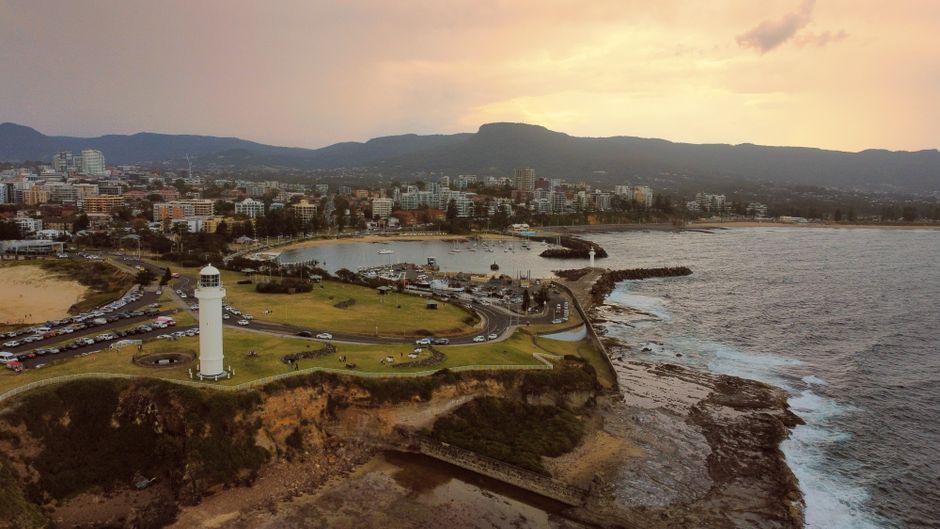
Tucked beneath one of New South Wales' most photographed landmarks, a convict-built rock pool has sat largely unacknowledged for nearly two centuries. Now a new walking tour in Wollongong is bringing that hidden history, and dozens of other overlooked stories about women who shaped the city, to the surface.
The secret beneath Flagstaff Hill Lighthouse
Most visitors to Flagstaff Hill Lighthouse in Wollongong stop for a photo and move on. Few realise that just below the guard rail, nestled against the base of the cliff in a sheltered rocky cove, sits what is believed to be the second-oldest rock pool in New South Wales, possibly in all of Australia.
Known as the Chains Bath, the pool was constructed in 1839 using convict labour and built specifically for women. Its name comes from the iron chains swimmers would grip when the ocean surged particularly rough. Despite its remarkable history, there is no signage at the site and no official acknowledgement of its existence.
Guide Lindsay Burlton, who leads the Wicked Women of Wollongong walking tour, says the omission is telling. "It's such a significant space for women in Wollongong's history and yet it is completely unacknowledged," she says. "It's an interesting parallel to women's history in general."
Colonial officials did not build the pool out of pure generosity. The motivation was more pragmatic: authorities wanted to attract women to a male-dominated population in order to bring stability to the colony.
The walking tour uncovering forgotten women's stories
The Wicked Women of Wollongong tour is the latest offering from She Shapes History, a company founded in 2021 by Sita Sargeant. The company runs similar tours in Canberra, Melbourne and Sydney, each focused on recovering the stories of women whose contributions have been largely written out of popular history.
Sargeant says frustration drove her to launch the business. "I launched She Shapes History out of sheer frustration, and grumpiness, at how little recognition women's historical contributions received in my home town of Canberra," she says. "I kept thinking, if we can't even acknowledge the women who shaped our own cities and made us who we are, how are we ever going to respect them and their contributions today?"
Landmark cases, cultural champions and wartime ingenuity
The Wollongong tour covers a remarkable breadth of women's history across the city. Among the stories told on the walk:
- A group of women who took steelmaker BHP to the Equal Opportunity Tribunal in the 1980s and won, in what became described as the biggest sex discrimination case in Australian history, permanently changing the face of industrial relations.
- Professional journalist Ethel Hayton, honoured by a laneway bearing her name just off Crown Street, who dedicated herself to transforming Wollongong from a coal city into a centre of arts and culture. Her contributions include the Wollongong Conservatorium of Music, the Wollongong Art Gallery and the Steinway concert grand piano in the Town Hall.
- Hotelier Hilda Condon, whose resourcefulness helped local inventor Evelyn Owen get the prototype for the Owen Gun, described as Australia's most successful wartime weapon, into a manufacturer's hands.
- Aboriginal rights campaigner Pearl Gibbs, who helped establish the Aboriginal-Australian Fellowship, a key organisation behind the successful 1967 referendum.
- Community activist Sally Bowen, who brought together eight diverse groups to march in Wollongong's first International Women's Day rally in 1979, described as a coalition that marched hand in hand, waving signs and beating drums through Crown Street Mall.
History hiding in plain sight
What makes the tour particularly striking is how many of these stories are set against familiar Wollongong backdrops, places residents and visitors walk past every day without knowing what happened there. The Chains Bath is perhaps the most vivid example: a structure that has endured for nearly 190 years in full view of a busy lookout, yet remains largely invisible to history.
For Burlton and Sargeant, that invisibility is precisely the point, and precisely why these tours exist.

