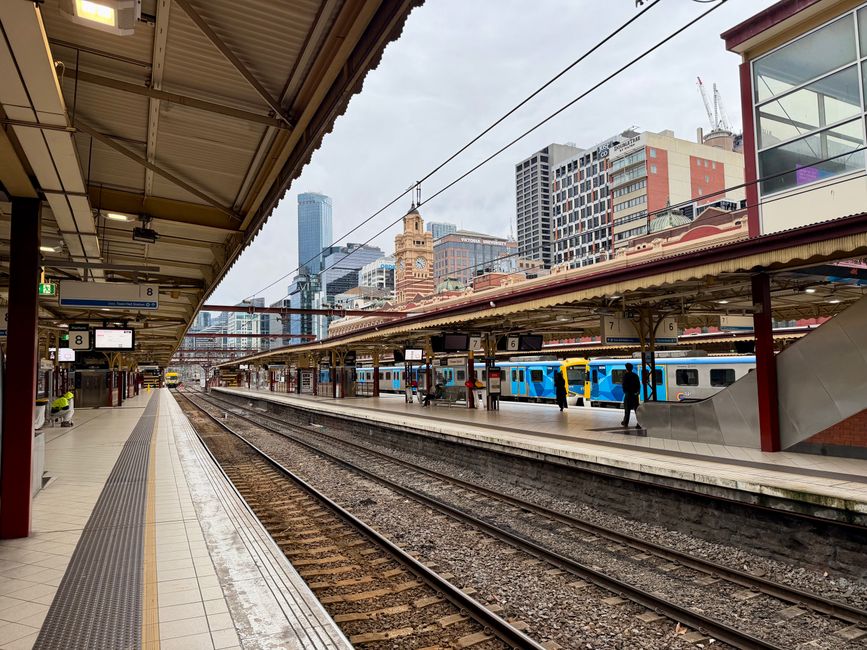
A major nationwide Telstra outage has forced the complete suspension of Victoria's regional train network on Wednesday morning, leaving tens of thousands of daily commuters stranded and prompting an urgent response from the federal government. The radio network fault, linked directly to the Telstra disruption, knocked out all V/Line services across the state with no estimated time for restoration announced as of early Wednesday.
All V/Line services suspended across Victoria
V/Line confirmed that services on every regional line — including the Bendigo, Seymour, Gippsland, Geelong and Ballarat lines — were suspended after a radio network fault rendered trains unable to operate. Around 70,000 Victorians rely on V/Line trains each day, and the disruption left dozens of services stopped in their tracks at regional and suburban Melbourne stations.
"Due to a radio network fault affecting the network, services are currently unable to operate," V/Line stated on its website. "There is no estimated time for rectification at this stage. Very limited coach replacement services will be available."
Passengers were urged to defer travel wherever possible. A Department of Transport spokesperson confirmed the root cause, stating that a Telstra outage was affecting V/Line services right across the state. V/Line said it was assessing the situation and would advise passengers when trains would resume.
Telstra outage hits every mainland capital
The disruption to Victoria's rail network is one of the most tangible consequences of a Telstra outage leaving thousands of customers without mobile service across Australia. The fault began affecting users before 5am AEST, with reports flooding into outage-tracking platform Downdetector from as early as 4.15am and peaking sharply around 6.30am. More than 7,000 reports had been lodged by early morning, with complaints coming from Sydney, Melbourne, Brisbane, Perth, Canberra and Adelaide, as well as regional centres across Victoria, Queensland and Tasmania.
Customers reported their phones dropping into SOS-only mode, an inability to make calls, and failed mobile data connections. Some businesses were also unable to process payments as a result of the outage. Telstra, which provides approximately 24.9 million retail mobile services and operates Australia's largest mobile network, confirmed it was investigating but had not identified a cause, provided an estimated fix time, or disclosed how many customers were affected.
"We're looking into an issue affecting some mobile calls and data connections," a Telstra spokesperson said, advising affected users to try restarting their devices or Wi-Fi services while the company worked on a resolution.
Federal government warns Telstra on emergency access obligations
Emergency Management Minister Kristy McBain issued a statement reminding Telstra of its legal obligations during the outage, particularly around ensuring Australians can still reach emergency services.
"The Australian government has been advised by Telstra that there is an outage affecting a large number of mobile calls and connections," the minister's office said. "Like all telcos, Telstra must notify customers and emergency services of any major outage. Australian phones are also required to fall back to other networks for 000 access."
The government said it was aware of the suspension of Victoria's regional train network and that arrangements were being made for affected rail passengers. Minister McBain confirmed Telstra was working to resolve the issue.
Some users reported difficulty reaching emergency services during the outage — a particularly sensitive concern given Telstra's history. In March 2024, a separate Telstra technical fault caused a failure to pass information to emergency services, during which a Victorian man died after emergency calls made by his family were delayed during his cardiac arrest. Telstra was subsequently fined $3 million following a regulatory investigation into that incident. New laws were introduced in the aftermath requiring telcos to proactively provide updates to customers during major outages.
Echoes of past network outages
Wednesday's disruption drew immediate comparisons to a significant telecommunications failure in November 2023, when an Optus outage knocked out Melbourne's train network. On that occasion, Metro Trains' systems failed and the network was unable to rely on its backup systems, with services taking nine hours to begin returning to normal.
Telstra also experienced a well-publicised major system failure in June of a recent year when it cut its mobile network coverage area by almost a third after new rules came into effect, forcing telcos to measure and report signal strength using standardised metrics to allow customers to compare networks more easily.
As of Wednesday morning, Telstra had not provided a timeline for restoring full service. V/Line passengers were being advised to defer travel, with only very limited coach replacement services available. The situation remained fluid, with authorities monitoring developments and the government pressing Telstra for a swift resolution to minimise further impact on commuters and businesses relying on the network.