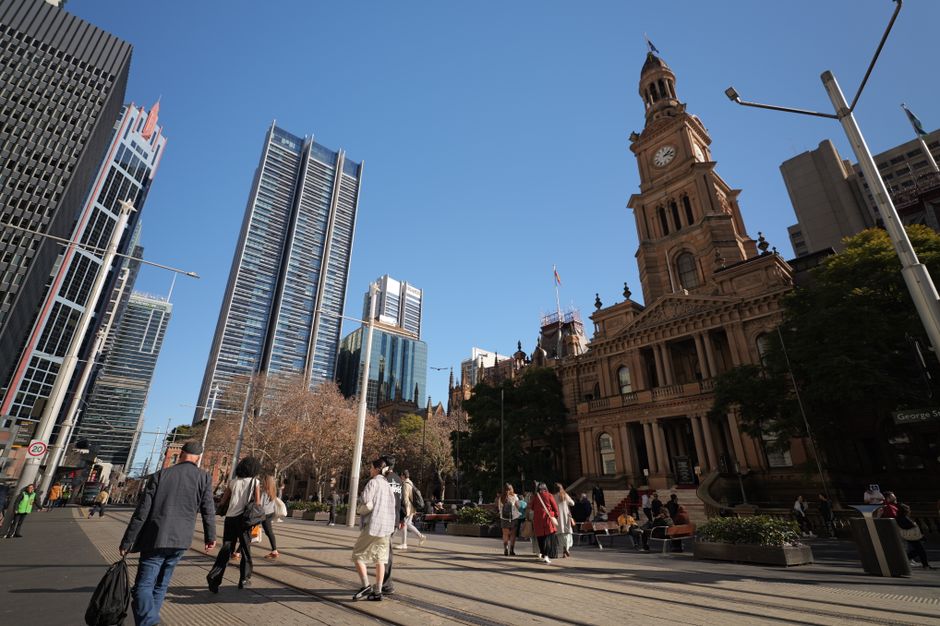
A controversial $150 million plan to demolish Australia's busiest Woolworths supermarket at Sydney's Town Hall and replace it with a public piazza has struck a significant obstacle, with the NSW government referring the proposal to the Independent Planning Commission to determine whether it qualifies as State Significant Development — a move that could hand the state the power to kill the project outright.
What the piazza plan involves
The proposal, championed by City of Sydney Lord Mayor Clover Moore, would see a wrecking ball taken to a stretch of buildings along Park Street, including the historic Hotel Coronation, a discount pharmacy and multiple floors of office space above. In their place would rise a signature public square featuring fountains, pavers, native trees and public seating, designed to double as an outdoor event space — a space, in the Lord Mayor's words, where people can "come together, spend time and connect."
The most high-profile casualty of the plan would be the Town Hall Woolworths — one of only two two-storey Woolworths supermarkets in Australia. The store has occupied the site since 1933 and draws approximately 6.5 million shoppers and tourists each year. It is also a key convenience stop for commuters passing through the adjoining train and Metro stations. A Big W store occupying the upper level would also be swept away under the plan.
State government steps in amid growing opposition
NSW Premier Chris Minns has stopped short of personally intervening to halt the proposal, but his comments have been widely read as the strongest signal yet that the state government is deeply uncomfortable with the Council's vision. "I'm not personally going to get involved and stop it," Minns said, before outlining a string of concerns that suggested the opposite sentiment.
"Those that live close to the city and need access to retail space have all said 'this is going to be a big impact on us'," the Premier said. He also pointed to the united front of unions and business groups pushing back against the plan. "The union's view is very clear and that is that you can't replace like for like and that they've got hundreds and hundreds of workers that are on that site and have worked there for a long period of time. I do think we have to take that into consideration."
Minns also noted the Chamber of Commerce had been "really strong" in its opposition, adding that retail space close to the city was "an important part of any government's consideration."
If the Independent Planning Commission determines the project meets the threshold for State Significant Development, the NSW government would gain the authority to override the City of Sydney and effectively veto the plan.
Jobs, retail space and community impact at stake
Opposition to the scheme has been fierce and broad-based. The Shop, Distributive and Allied Employees Association has warned that up to 1,000 jobs are at risk if the demolition proceeds. Business Sydney has also come out strongly against the proposal.
Woolworths itself has argued there is simply no comparable site in the Sydney CBD capable of accommodating its 5,000-square-metre supermarket, raising doubts about whether any meaningful relocation is even feasible. The supermarket chain has occupied the Town Hall site for more than nine decades, making it one of the longest-running retail tenancies in the city's history.
Shoppers, nearby residents and retail workers have all raised alarms about what the loss of such a major grocery outlet would mean for day-to-day life in the inner city — concerns that appear to have resonated at the state level.
What happens next
The referral to the Independent Planning Commission marks a fresh escalation in the ongoing tension between the NSW government and the City of Sydney over the future of one of the CBD's most-visited corners. A determination on whether the project qualifies as State Significant Development will be the critical next step — and could determine whether the piazza ever gets off the drawing board.
The dispute adds to a broader conversation about how Sydney balances urban amenity ambitions with the practical needs of residents and workers. The city's ongoing housing and retail pressures make the loss of central, accessible services a particularly sensitive issue for many inner-city communities.