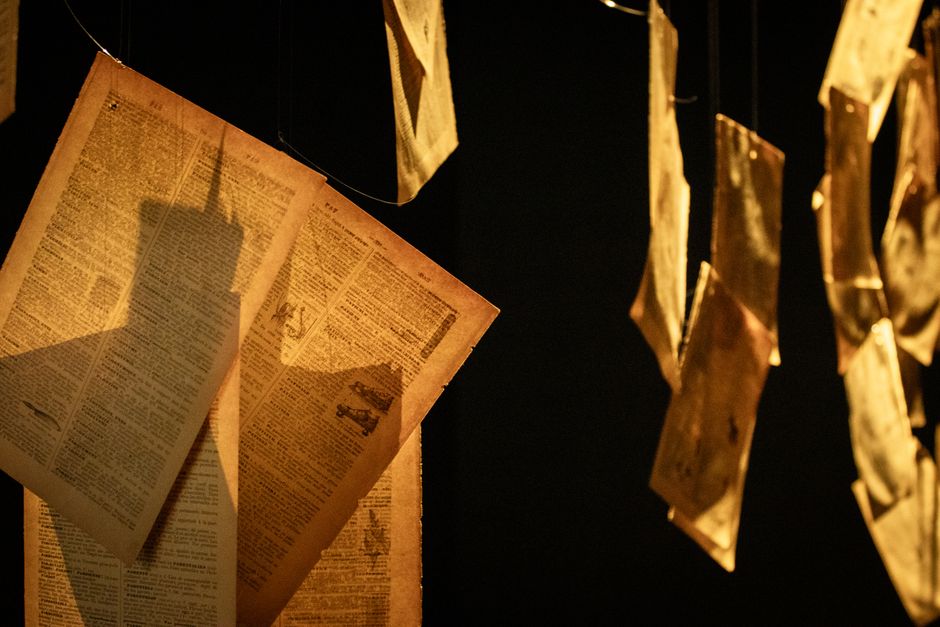
A new exhibition at Town Hall Gallery inside the Hawthorn Arts Centre in Victoria is inviting visitors to do something increasingly rare: slow down, put their phones away, and give art their undivided attention. Slow Read, featuring works from nine multimedia and collage artists from across Australia, is a deliberate counter to the culture of endless digital scrolling — celebrating instead the tactile, contemplative world of the printed page.
The show brings together a diverse group of practitioners whose works transform books and printed materials into multi-dimensional, hands-on experiences that reward patience and presence.
Art That Demands — and Rewards — Your Full Attention
Exhibition curator Rachel Keir-Smith says the works on display offer something meaningful to those willing to take their time with them. "The artworks can offer a rich and meaningful encounter when viewers are open to them, but this requires time," she says.
Among the contributors are Gracia and Louise, a Melbourne-based duo who have been collaborating on collages, prints, zines and drawings — often depicting nature — since 1999. Venezuelan-born artist Nadia Hernández also features, with her work Palomita/Soledad (roughly translating as Little Dove/Solitude), which weaves together verse fragments drawn from a poem written by her grandfather.
Also represented is Jayda Wilson, an emerging First Nations artist of Gugada, Wirangu, and Thai descent who lives in Karna Yauta (South Australia), whose contribution is titled (un)silenced.
A Year of Weaving: Jacky Cheng's Thrums
One of the most striking works in the exhibition is Thrums, by Jacky Cheng — a Malaysian-born artist of Chinese heritage who lives and works on Yawuru Country in Broome, Western Australia. The title plays on the dual meanings of the word "thrum": both a steady, repeated sound like a hum, and, historically, the leftover thread from a loom.
Cheng's piece evokes a visualised wave of sound, constructed by weaving together offcuts of kozo paper and old calendars — including some that had belonged to her grandmother — before stitching them with nylon thread. The stitching process alone was extraordinarily labour-intensive, with Cheng spending close to a year completing the work.
"These printed fragments, once part of a daily ritual of tearing and marking time, carry embedded systems of language, belief and cultural rhythm," she says of the piece.
For Cheng, weaving is a metaphor as much as a method. "Individual pieces of paper might hold one story, but when they're woven together, they create a relationship with one another," she explains. "The process mirrors how identities form; not just a single narrative, but through many overlapping experiences, memories and cultural influences."
Fighting the Scroll: How One Artist Manages Screen Time
Cheng, who is also a visual arts teacher, is candid about the fact that she is not immune to the distractions of the digital world. But she has developed habits — and even a touch of humour — to keep herself focused. She now answers emails in the morning before dedicating four or five solid hours to her art practice each day.
She has also come up with a quirky personal solution to phone dependency. "I made this cardboard phone," she says with a laugh. "I place it on the table, and I'll look at it and say 'See, I've got no messages!'"
Her weaving practice, she says, is the antithesis of mindless scrolling. "The act of weaving, it's the opposite. It's repetitive, deliberate and definitely time-intensive. The work really asks the audience to spend time with it rather than immediately understand it. The meaning unfolds gradually."
In a media landscape where everyday Australians are grappling with information overload, Slow Read makes a compelling case for the value of stopping, looking closely, and letting meaning reveal itself over time.