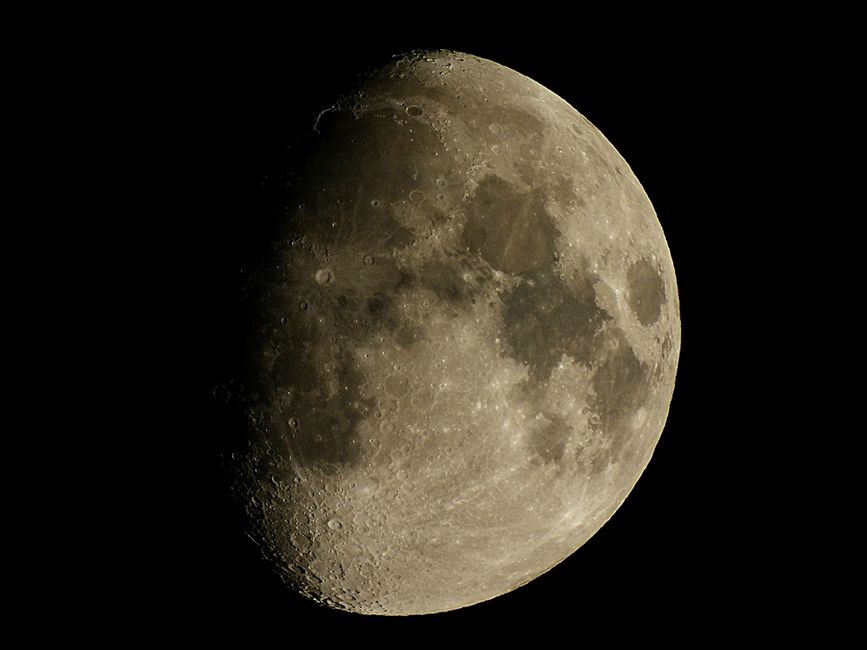
A school-bus-sized chunk of a SpaceX Falcon 9 rocket has crashed into the Moon, with scientists confirming the impact occurred on Wednesday afternoon Australian time. The 4,000-kilogram upper stage — which had been drifting through space for more than a year after launching two private lunar landers in January 2025 — struck the lunar surface at roughly 8,690 kilometres per hour, near Einstein Crater on the Moon's sunlit western limb.
No one directly observed the moment of collision, but a telescope in Chile detected what astronomers identified as a debris plume stretching tens of kilometres into space, providing strong indirect confirmation of the strike. Scientists say the crash was entirely unintentional, the result of solar activity and gravitational forces gradually bending the rocket's path onto a collision course with the Moon.
What the telescopes captured
Planetary scientist Carl Schmidt from Boston University said he is "100 per cent certain" his team's observations revealed signs of the lunar crash. The European Southern Observatory's Very Large Telescope detected a stream of sodium and lithium extending for tens of kilometres into space, persisting for at least five to ten minutes following the estimated impact time.
"We don't have images of the impact," Schmidt acknowledged, "but there is telescope evidence." The impact flash itself — lasting less than a second — was always expected to be too dim to observe from Earth, and the crash site near the boundary of the Moon's near and far sides made direct observation especially challenging.
Retired astrophysicist Jonathan McDowell said observations of the dead rocket stage the night before the impact already showed it heading directly for the Moon. "There's no doubt in my mind," he said, that the rocket "is now in teeny, little pieces scattered over the Moon near Einstein Crater." Dutch scientist Marco Langbroek also trained his telescope on the Moon at the anticipated moment of impact but was unable to capture visual confirmation. "We knew this would be a long shot," he said, adding he nevertheless had "no doubt" the rocket met its end as predicted.
Scientists had anticipated the impact would carve out a crater roughly 27 metres across and five metres deep — far too small to be resolved from Earth, but clearly visible to orbiting spacecraft.
How the rocket ended up on a collision course
The Falcon 9 upper stage originally launched two private lunar landers on 15 January 2025. One of those landers — Firefly Aerospace's Blue Ghost — became the first private spacecraft to achieve a fully successful lunar touchdown. The second lander, built by Japan-based ispace, did not survive its descent.
After deploying its payload, the rocket's second stage was left in an unstable orbit with no ability to perform a controlled disposal burn. Julianna Scheiman, SpaceX's director of Dragon Human Spaceflight, said a combination of solar activity and gravitational forces gradually pushed the spent stage onto its fatal trajectory. She stressed the impact was not deliberate, and said SpaceX is working with NASA to prevent similar outcomes in future missions. Experts noted the collision could have been avoided had the upper stage been nudged into a stable solar orbit after its mission was complete.
The energy released on impact was estimated to be equivalent to roughly three tonnes of TNT — significant enough to generate a visible ejecta plume, though the event unfolded in one of the Moon's harder-to-observe regions.
Growing concern over lunar litter
The incident is the latest example of what scientists are calling lunar litter — human-made debris accumulating on the Moon's surface. In 2022, a Chinese rocket segment accidentally struck the lunar far side, digging out a pair of craters. Researchers suspect other untracked rocket stages may have hit the Moon in past decades without anyone's knowledge.
Benjamin Fernando of Los Alamos National Laboratory said understanding these impacts carries practical importance beyond scientific curiosity. "Part of the reason for our interest in this event is to figure out how much of a hazard debris impacts pose to future astronauts," he said. That concern is sharpening as both the United States and China accelerate plans to return humans to the lunar surface, and as commercial space activity increases the volume of hardware being launched toward the Moon.
Space tracking expert Bill Gray, who has been following the rocket's trajectory for months, previously noted that "things are getting crowded up there" — a sentiment echoed by others in the field who see this crash as a timely prompt to tighten debris management protocols. Observers of SpaceX's broader commercial trajectory will be watching closely to see how the company responds to mounting scrutiny over its space-junk footprint.
What happens next
Visual confirmation of the new crater is expected to come from NASA's Lunar Reconnaissance Orbiter, which is due to fly over the crash site and return photographs — though NASA does not expect that imagery to be available until next week. South Korea's Danuri lunar orbiter was also positioned to gather before-and-after images of the scene, with calculations suggesting it passed within a kilometre or two of the rocket just two minutes before impact.
Scientists say the event echoes NASA's deliberate practice during the Apollo era of crashing rocket sections and lunar modules into the Moon to generate seismic data — a reminder that controlled and uncontrolled lunar impacts alike offer valuable scientific insights, even as the uncontrolled variety raises increasingly urgent questions about how humanity manages its growing presence in cislunar space.