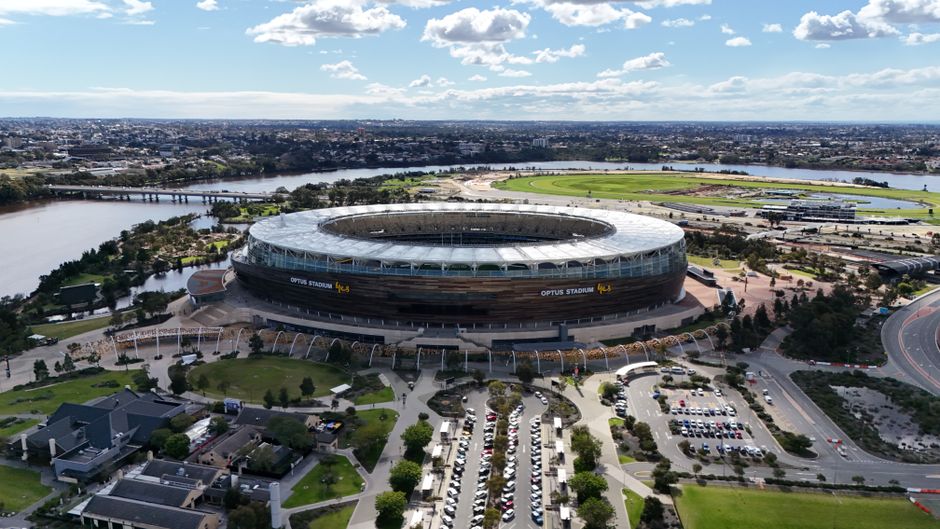
Every time a drone lifts above Optus Stadium during an AFL broadcast, it captures something that no amount of clever camera work could manufacture — a naturally spectacular Perth skyline that has made the Burswood venue the envy of sports broadcasters across the country.
The aerial shots that have become a staple of football coverage from Perth frame the stadium glowing beside the Swan River, the Matagarup Bridge arcing gracefully nearby and the city skyline rising behind it — a composition that looks less like a broadcast shot and more like a tourism campaign. The view, broadcast to national audiences, has effectively turned Optus Stadium into the defining image of modern Perth.
Why Burswood Made All the Difference
When Perth was debating where to build its new major stadium, Burswood was not the only option on the table. Among the sites seriously considered was Cockburn, located roughly 20 kilometres south of the CBD. Reviewing archival footage of that debate now, it is genuinely difficult to understand how a location so far removed from the city's visual heart was ever a contender.
A stadium at Cockburn may well have functioned perfectly as a football ground — the same seating capacity, the same floodlights, the same atmosphere inside the bowl. But it would have produced none of the sweeping aerial imagery that now accompanies every major Perth broadcast. More critically, it would not have given national television audiences the feeling that an event is woven into the fabric of the city hosting it.
The drone, in this sense, is not creating the image — it is simply revealing what was already there, placed almost perfectly by geography and planning.
How Drone Technology Changed the Way Stadiums Are Judged
Before drones became a routine part of sports production, aerial vision was reserved for the biggest occasions. Securing that kind of footage meant hiring a helicopter, putting a camera operator in the air, establishing broadcast links and spending significant money. Today, low-level drone shots are a built-in feature of almost every televised sporting event.
That shift has changed how stadiums are perceived — a venue is no longer judged solely by what happens inside it. The surroundings matter. The backdrop matters. And on that measure, Optus Stadium has very few rivals anywhere in the country.
Drone operators working AFL broadcasts on the east coast have taken notice. While other venues have invested in upgrades like coloured lighting and LED displays to boost their visual appeal, those additions alone do not produce the kind of organic, city-embedded spectacle that Perth delivers from the air. The reaction from interstate colleagues, by all accounts, is one of genuine envy.
A Precinct Still Growing — and a New Element Taking Shape
The Burswood precinct that made Optus Stadium so visually compelling is not finished evolving. A new racetrack is currently taking shape in the same area, visible in recent aerial footage captured during broadcasts. The development has already attracted its share of community debate, and opinions on it remain divided.
From the air, however, the emerging facility hints at something more — the potential for yet another venue to become part of Perth's growing aerial postcard, another piece of infrastructure placed where the city itself becomes an integral part of the visual frame.
For the many Australians who will never attend a game in person, these broadcast drone shots are effectively how they experience Perth. The decision to plant a major stadium in Burswood, beside a river, beneath a skyline, with a bridge as a natural foreground element, was not just good urban planning. It was, whether intended or not, a masterclass in place-making for the television age.
For fans of Perth-based sport curious about how other major venues measure up under similar broadcast scrutiny, the contrast with on-ground coverage from stadiums interstate underscores just how rare the Optus Stadium setting truly is.