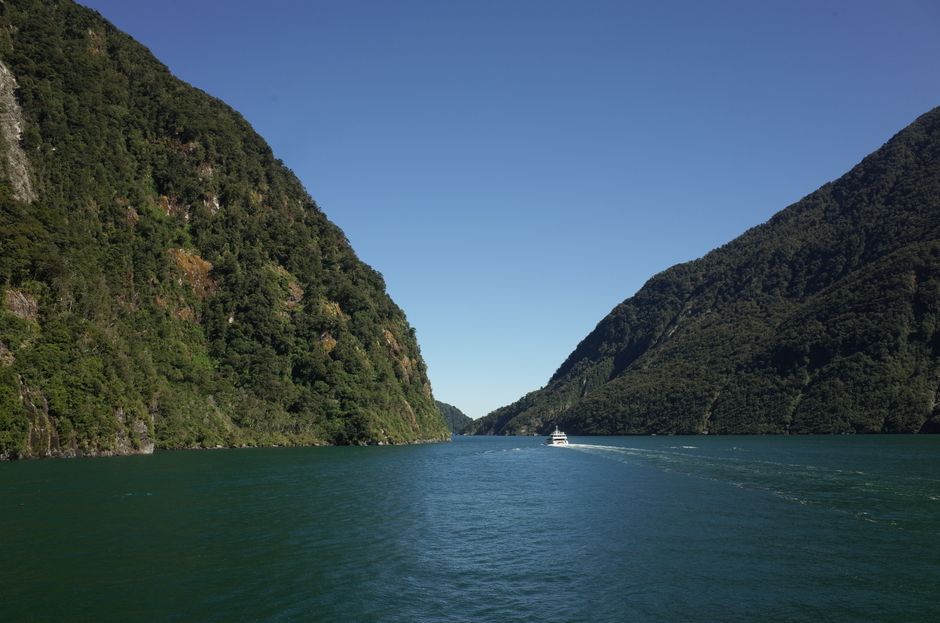
While Norway's fjords attracted a record 1.6 million cruise passengers in 2025, the southern hemisphere's equivalent — New Zealand's spectacular Fiordland — remains one of the world's best-kept travel secrets. Of the 1.48 million Australians who visited New Zealand last year, fewer than 1,000 made it to Fiordland by expedition boat, leaving one of the planet's most breathtaking wilderness regions almost entirely to itself.
A World Heritage wilderness hiding in plain sight
Fiordland occupies the south-west corner of New Zealand's South Island, encompassing 14 fjords spread across 12,000 square kilometres of World Heritage-listed national park. While Milford Sound — the region's northernmost fjord, accessible by sealed road — drew around 800,000 visitors in 2025, the remaining 13 fjords are reached only by a handful of expedition vessels.
The largest of these, Dusky Sound, stretches roughly 40 kilometres, yet during a recent six-night expedition aboard Fiordland Jewel — an 18-passenger, 24-metre catamaran purpose-built for these waters — the only other vessel encountered across the entire journey was a three-person lobster boat on the final day. The silence, one traveller noted, was almost claustrophobic.
"Fiordland has to be the loneliest place on Earth," says skipper Francis Brundell. "It's a beast. God, I love it."
The sentiment echoes words written more than 250 years ago. When Captain James Cook became the first non-indigenous visitor to Fiordland during his second expedition in 1773, his naturalist Johann Forster observed: "Here, was the deepest silence. Nature was hushed, not a breath of wind penetrated to this sheet of water enclosed by high mountains and great forests." Remarkably little has changed since — there are no roads in, no towns, and virtually no sign that humans have ever set foot here.
Getting to Fiordland is easier than most Australians realise
The perceived remoteness of Fiordland may explain why so few Australians make the journey — but the logistics are far simpler than the destination suggests. A flight from Australia reaches Queenstown in under three hours. From there, a two-hour drive leads to the village of Te Anau, followed by a 45-minute helicopter flight to Preservation Inlet at New Zealand's south-westernmost point. Total travel time from Australia: less than six hours.
Guests board Fiordland Jewel directly via a helipad on the vessel's top deck — and the helicopter approach itself is an experience, threading through snow-capped peaks and emerging hundreds of metres above the inlet where the boat sits at anchor. From Preservation Inlet, the expedition winds north through Chalky Inlet, Dusky Sound and Breaksea Sound before finishing at Doubtful Sound, the deepest and second-largest fjord in New Zealand.
No two itineraries are identical. "I know the beginning and the end point," Brundell explains. "Then the rest is set by the weather. You can't plan a trip in Fiordland, no two trips are the same."
Wildlife, waterfalls and a window into ancient Gondwanaland
The region's isolation has preserved an extraordinary natural world. Bottlenose dolphins — up to four metres long and as heavy as a horse — frequently ride the bow waves of expedition vessels. Fiordland crested penguins and New Zealand fur seals are common sightings, both apparently unbothered by the presence of the occasional passing boat.
Rainfall is constant in the fjords, and the steep, heavily forested mountain slopes transform into cascading waterfalls after every shower — too many to count. Aboard Fiordland Jewel, the top-deck hot tub offers one of the more memorable vantage points for watching the cascades appear and vanish in the mist.
The vegetation here has remained largely untouched since the time of the ancient supercontinent Gondwanaland, giving the landscape an otherworldly, almost primordial quality — and Fiordland one of the longest European histories of any part of New Zealand. For Australians in search of genuine wilderness less than a day's travel from home, it may be the most overlooked destination on the planet.