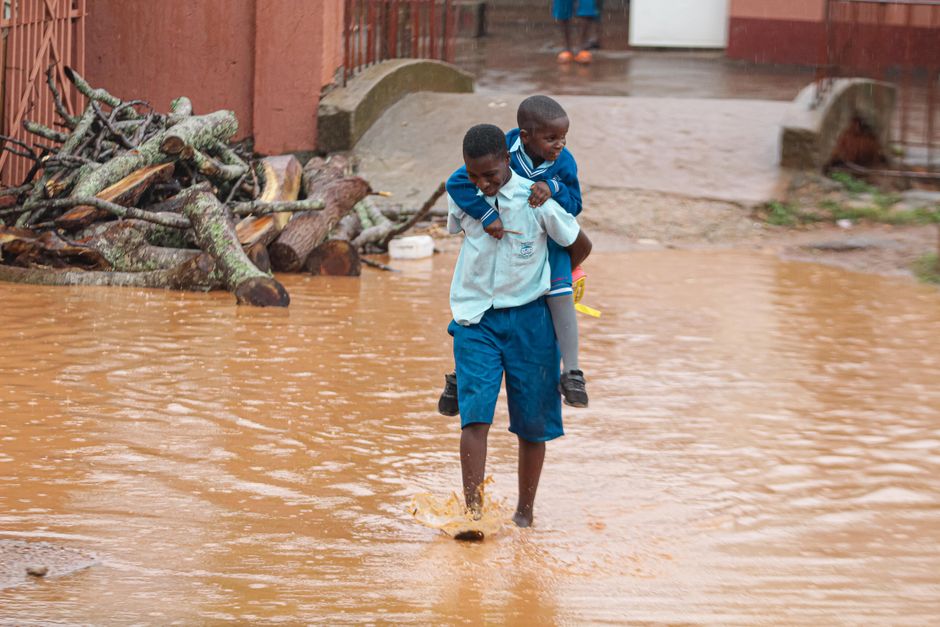
When floodwaters began tearing through Nepal's Trishuli Valley last week, school principal Rajendra Dawadi had only minutes to make a decision that would save the lives of hundreds of children. He rang the school bell, ordered everyone out, and led nearly 900 students to the safety of a nearby hillside — moments before the building he had attended as a child, and later taught in as an adult, was swallowed whole by a torrent of water, mud, boulders and debris.
The flash floods, unleashed after a glacial collapse in the Himalayas, have since killed more than 950 people across Nepal and Tibet, with over 4,400 still unaccounted for. Dawadi's swift response at Tribhuvan Trishuli Secondary School has become one of the most striking stories of individual courage to emerge from the catastrophe.
A warning, a bell, and seconds to spare
Dawadi was inside a classroom when a colleague rushed in with urgent news: floodwaters were racing through the valley. A teacher then received a warning by phone, and shortly after, a parent arrived at the school gates to collect their child. The threat had not yet been officially confirmed, but Dawadi did not wait.
"I immediately decided to stop school and get the children out," he said.
He rang the school bell — the signal that would trigger an evacuation — and directed students and staff toward higher ground. As he followed them up the hill, the waters were already rising behind him. From the hillside, he turned and watched the school disappear.
Tribhuvan Trishuli Secondary School had a total enrolment of 1,643 students. At least 900 were on campus that morning, with others still making their way in. Dawadi not only ordered those on school grounds to leave, but called bus drivers and instructed them to turn back. One bus carrying students had already arrived at the school when Dawadi told the driver to reverse. The bus crossed a newly built bridge and cleared it safely; moments later, the old bridge beside it collapsed.
Two staff members were unable to make it out and remain missing.
A school that meant everything
For Dawadi, the loss of the school is not simply an institutional tragedy — it is deeply personal. He studied there as a boy and spent years of his professional life teaching within its walls.
"I have no words. I got education from that school. And I gave education at that school," he said.
When he returned to the site days after the disaster, parents rushed to embrace him. They wept. They thanked him for saving their children's lives.
"Their parents hugged me, they cried with me," Dawadi recalled. "They were emotional."
Among those whose lives he is credited with saving is 14-year-old student Suvina Tamang, who confirmed the building was swept away shortly after students had been evacuated. "I will thank him when I see him," she said, "for saving my life."
Despite the outpouring of gratitude, Dawadi is reluctant to accept the label of hero. In his view, getting his students to safety was simply his responsibility as principal — nothing more and nothing less.
Thousands of children left without classrooms
The destruction of Dawadi's school is far from an isolated case. Across northern Nepal, the floods have gutted communities and left thousands of children without any place to learn.
Aid organisation Save the Children has reported that at least 69 schools in northern Nepal were destroyed in the disaster, placing the education of nearly 19,000 students in jeopardy. Efforts to bring relief to the worst-affected regions are expected to continue for months.
The scale of disruption raises serious concerns about the long-term impact on children's schooling, with fears that the disaster could cost students months of learning — on top of the psychological trauma many are already experiencing.
What comes next for students and survivors
Dawadi himself is already thinking ahead. He says students will need psychological counselling before any meaningful return to education can happen. After that, he insists, lessons must begin again — even if there is no school building left to teach in.
His story has resonated widely as Nepal confronts the human cost of one of its worst natural disasters in recent memory. For a country already prone to devastating monsoon seasons, a glacial collapse of this scale has compounded an already fragile situation for communities throughout the Himalayas.
Relief efforts are ongoing, and the full extent of damage to infrastructure, homes and schools across the Trishuli Valley and surrounding districts is still being assessed. For Dawadi, however, the priority is clear: the children who walked away from that hillside need support, stability, and eventually, a classroom to return to.