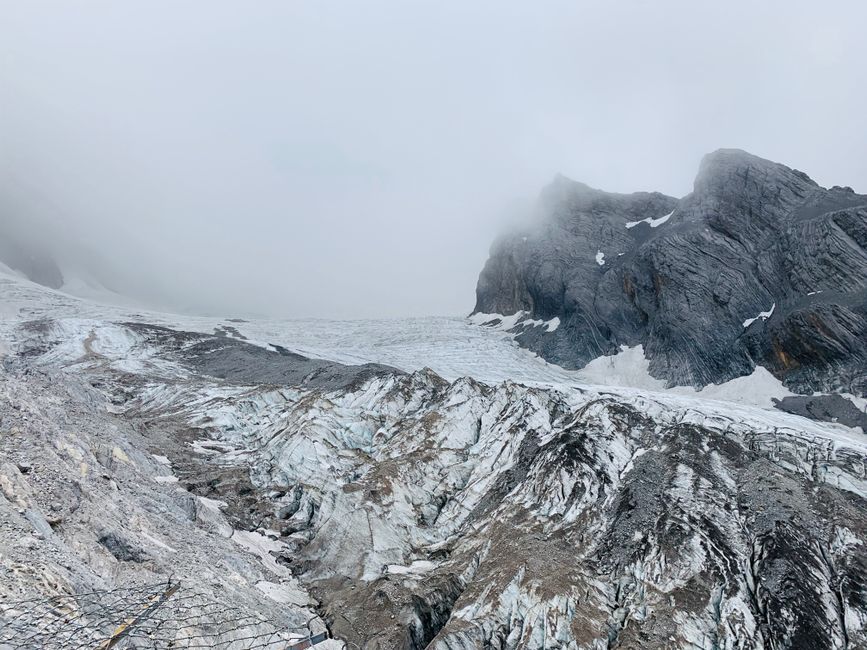
A devastating glacier collapse on the Nepal-Tibet border has sent shockwaves through the scientific community, raising urgent questions about whether mountain regions worldwide — including parts of New Zealand — are becoming increasingly vulnerable to catastrophic cascading disasters as the planet warms.
What Happened on the Nepal-Tibet Border
Preliminary analysis indicates that a massive body of ice and rock broke away from the slopes of Langtang Lirung, a mountain exceeding 7,000 metres above sea level. The debris crashed into the Lhende Khola river, triggering an enormous surge of water, sediment and boulders that tore through the valleys below.
The force of the event was so immense that seismic instruments initially registered it as a magnitude 5.2 earthquake. Scientists later determined the seismic signal was generated by the collapse itself, not a tectonic event. Water levels downstream surged by as much as nine metres in just 30 minutes, according to experts.
One possible sequence of events under investigation is that the collapsed material temporarily blocked the river, forming a natural dam before the impounded water broke through catastrophically. Scientists are still working to establish the precise chain of events.
Climate Change and Glacier Instability
Experts are cautious about attributing this specific disaster directly to climate change, noting it is too early to draw that conclusion. The Himalayas are among the world's most tectonically active regions, meaning earthquakes, heavy rainfall and the natural movement of glaciers can all independently trigger collapses.
But scientists warn that rising temperatures are fundamentally altering the conditions that hold high-altitude landscapes together — and that warming can create environments in which a natural trigger produces a far more dangerous chain reaction than it otherwise might.
Key mechanisms include:
- Glacial retreat: As glaciers lose ice, they cease to act as buttresses supporting steep mountain slopes, exposing bare rock to warmer air, rainfall and freeze-thaw cycles.
- Meltwater penetration: Water seeping into cracks in exposed rock can progressively weaken slopes over time.
- Permafrost thaw: Ground that has remained frozen for years provides structural stability; when it thaws, that support is lost.
Dr Simon Cox, Chief Scientist at Earth Sciences New Zealand's Mountains to Sea programme, has stated that climate change is generating conditions capable of destabilising high-mountain rock and ice, and that such collapses — along with the cascading hazards they produce — could become more frequent as warming continues.
New Zealand's Southern Alps Face Comparable Hazards
While the danger may seem remote to Australians and New Zealanders, scientists say the underlying physics are not. New Zealand's Southern Alps share many of the same physical characteristics as the Himalayas — glaciers, steep mountain faces, ice and snow, and narrow valleys where a sudden collapse could send enormous volumes of rock, ice and water downstream.
The human exposure is markedly different from Nepal's, with far fewer people living in New Zealand's highest mountain terrain. But experts say the geological and glaciological hazards are genuinely comparable, and that a warming climate could make those mountains progressively less stable in the years ahead.
A Broader Global Warning
The disaster on the Nepal-Tibet border is a stark illustration of how climate change can reshape not just coastlines and weather patterns, but the very structure of mountain environments that billions of people depend on for water, and which millions more live beneath. As glaciers retreat and permafrost thaws across high-altitude regions globally, scientists are warning that the risk of cascading mountain disasters — floods, landslides and collapses — is likely to grow, regardless of whether any single event can be directly linked to warming.
The scientific message is clear: the conditions that make such disasters possible are becoming more common, and communities living in the shadow of glaciated peaks — anywhere in the world — should be paying attention.