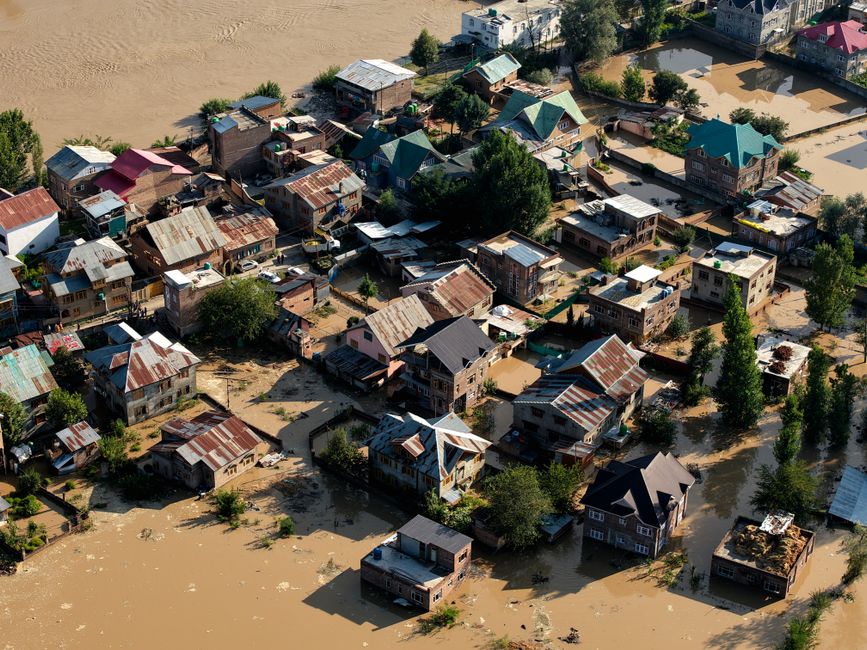
Nepalese authorities have estimated that around 20,000 homes will need to be rebuilt in flood-devastated regions after a catastrophic glacier collapse last week killed at least 1,252 people, with more than 4,200 still unaccounted for and rescue teams continuing to search tunnels linked to hydropower projects for survivors.
Scale of destruction: 7,500 homes gone, thousands more uninhabitable
The disaster was triggered on 26 August when a glacier collapse sent a torrent of ice, rock and mud surging through Nepal's border region with China, obliterating settlements and villages across multiple districts.
The chief of Nepal's National Disaster Risk Reduction and Management Authority said preliminary assessments found 7,500 homes had been completely destroyed — either swept away entirely or buried beneath debris and mud. However, authorities stressed the true housing crisis runs far deeper, as many structures left standing are no longer safe to live in.
"Our preliminary estimates are that 7,500 houses have been completely destroyed, either washed away or buried under debris and mud," the authority's chief said, adding that the total number requiring reconstruction across safer locations was closer to 20,000.
The affected districts include Timure in Rasuwa, Nuwakot, Dhading, Chitwan and Nawalparasi East. Towns, villages, streets and schools near the border with China's Tibet region were among those swept away in the deluge. Thousands of residents have been displaced.
Search and rescue: tunnels, tunnels and a race against time
More than 9,300 Nepali army troops are deployed across affected areas, engaged in search and rescue operations, body recovery, road clearance and emergency medical assistance.
A significant and ongoing focus of rescue efforts is a series of tunnels connected to hydropower projects, where experts believe at least 900 people may still be trapped alive. Specialists from India, South Korea and China are working alongside Nepali forces in those operations.
"The search-and-rescue operation will continue as long as there is any hope of finding survivors. Even if there are no survivors, we will recover the dead bodies," an army officer involved in the effort said. Two bodies have already been retrieved from the tunnel of the Langtang Khola hydropower plant.
At least 583 foreign nationals are among the missing, many of them pilgrims and trekkers who were in the region at the time of the disaster.
International response: Australia, China and others step up aid
China has dispatched a third round of emergency aid to Nepal, including tents, blankets, medical protective suits and satellite communication equipment. Beijing's foreign ministry confirmed the two countries' meteorological agencies are now in direct contact, and pledged to continue providing assistance based on Nepal's evolving needs.
On the Tibetan side of the border, China has reported 21 deaths with 541 people listed as missing. Access to the affected area in Tibet remains tightly restricted for foreign journalists, with updates largely filtered through state media. As of Wednesday, rescue teams were able to reach the site of the former Gyirong border crossing complex, bringing excavators and specialised equipment.
Australia has pledged additional support to Nepal and confirmed it would share telecommunications data with Nepali authorities to assist in narrowing search areas — a step welcomed after an Australian medical student whose partner went missing near the Nepal-China border publicly called on technology companies to release tracking data that could help direct rescue teams more precisely.
What comes next: rebuilding lives from scratch
With tens of thousands of people displaced and entire communities wiped from the map, Nepal faces an enormous reconstruction challenge. Authorities have indicated that surviving homes cannot simply be repaired — many must be rebuilt in entirely new, safer locations to reduce future risk.
"People have lost everything," one account from the ground noted, with residents lacking even basic identification documents amid the chaos.
The human toll continues to mount as search operations press on, and the full extent of the disaster — in lives lost, homes destroyed and communities shattered — is still being counted.