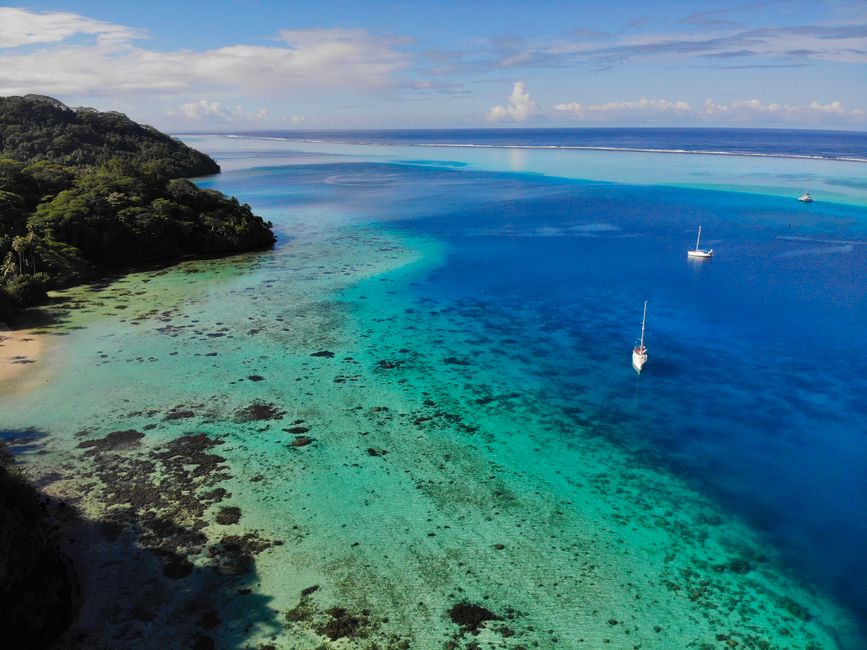
The Pacific island nation of Nauru has officially changed its name to the Republic of Naoero, reverting to the indigenous name that European colonisers set aside centuries ago because they found it difficult to pronounce. The constitutional amendment marks one of the most symbolically significant acts of cultural reclamation in the Pacific in recent years, and places the tiny nation within a broader global movement of countries shedding colonial-era identities.
A name that was always there
Naoero's parliament passed the constitutional amendment in May, with the government initially flagging a national referendum to formalise the change. That referendum plan has since been abandoned, with President David Adeang explaining the decision in a public statement that framed the move not as something new, but as a formal recognition of what already existed.
"The decision not to pursue a referendum was reached after thoughtful deliberation that Naoero is not a new name seeking acceptance by the people," Adeang said. "It is already the identity of the people, is on the national coat of arms, and spoken in the community; and importantly is allowed by the constitution."
Under the change, the abbreviated national name will be Naoero, while citizens will now be referred to as dei-Naoero. The government has already formally notified international organisations and other countries of the change, with the transition process described as underway.
Adeang was emphatic that politics played no role in the decision. The name change, he said, was about "preserving the legacy of our ancestors and strengthening the future of our children" — a statement of heritage rather than a partisan act.
Naoero is among the world's smallest nations, ranking third behind Vatican City and Monaco, with a population of approximately 12,000 people. Despite its size, the country's decision has attracted international attention as a clear example of a growing post-colonial trend.
How colonial naming reshaped Naoero
The original name Naoero was altered by European colonisers who struggled with its pronunciation, anglicising it to the more familiar "Nauru." For generations, the traditional name continued to be used locally — appearing on the national coat of arms and spoken in everyday community life — even as the colonial version became the internationally recognised form.
The formal reversion corrects that historical distortion, aligning the country's official international identity with what its people have always called home.
Naoero joins a long line of nations reclaiming their names
The Republic of Naoero is far from alone in taking this step. Over the past five decades, a quiet but persistent wave of nations — particularly those emerging from colonial rule — has seen countries formally return to traditional or locally meaningful names.
In the Pacific, Naoero's immediate neighbours set precedents decades ago. Tuvalu and Kiribati both reclaimed their names in the late 1970s, replacing the colonial-era designations of the Ellice Islands and the Gilbert Islands respectively. Vanuatu followed in 1980, retiring the name New Hebrides upon independence.
Timor-Leste adopted its current name in 2002 after achieving independence, having previously been known by the Indonesian designation Timor Timur — a name that, like Timor-Leste itself, translates roughly to "East East."
The trend is by no means confined to the Pacific. In Africa, Eswatini retired the colonial name Swaziland in 2018 to mark the 50th anniversary of Swazi independence — a change that also conveniently resolved long-standing confusion with Switzerland. Namibia dropped the name Southwest Africa in 1990. Côte d'Ivoire rejected the English translation "Ivory Coast" in all official contexts back in 1986 and has since refused to acknowledge any version of its name other than the French. Cabo Verde formally ended international use of the anglicised "Cape Verde" in 2013, after its national delegates asked the United Nations to use only the Portuguese form.
Beyond the developing world, Türkiye offers one of the more recent high-profile examples. President Recep Erdoğan began pushing for the traditional spelling and pronunciation in 2021, arguing it better represented "the culture, civilisation and values of the Turkish nation." The change was subsequently recognised by major international bodies.
What the change means going forward
For Naoero, the formal transition is already in motion. International bodies and foreign governments have been notified, and the administrative work of updating official documentation, signage, and correspondence is underway. The abbreviated name "Naoero" will be used in day-to-day international contexts, while the full designation remains the Republic of Naoero.
President Adeang has framed the entire exercise not as a rejection of the present, but as a reaffirmation of something that was never truly lost — a distinction that helps explain why a referendum was ultimately deemed unnecessary. The people of Naoero, his government argued, were not being asked to accept a new name. They were simply watching the world catch up to the one they had always used.
As more nations examine their colonial histories and reassert indigenous identities, Naoero's move is likely to be seen as part of an enduring and broadening cultural reckoning — one that shows no sign of slowing.