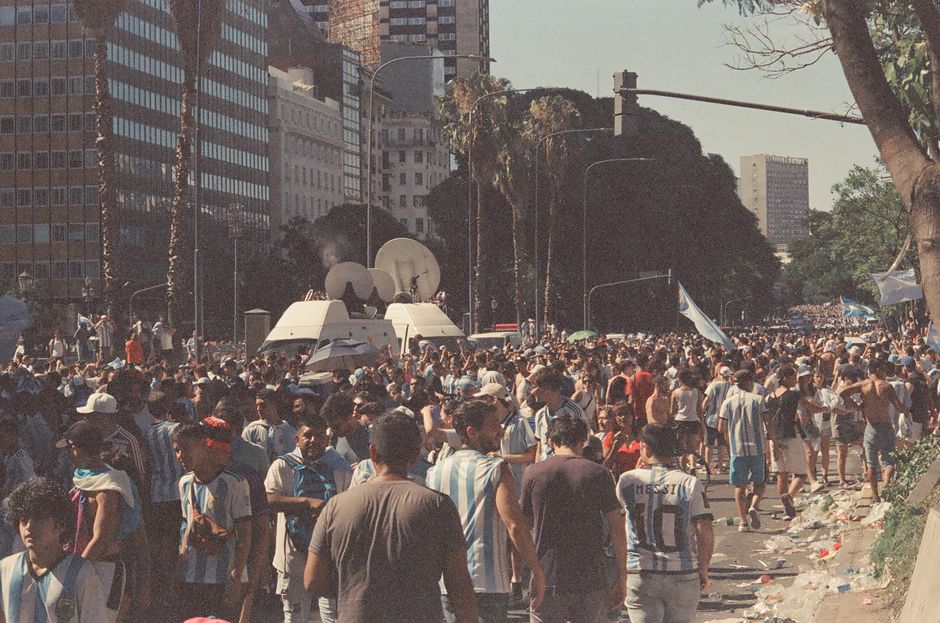
Lionel Messi did not score, but he did something arguably more important — he rescued Argentina when it mattered most. The 39-year-old superstar provided two decisive assists as La Albiceleste clawed back from a goal down to defeat England 2-1 in the FIFA World Cup semifinal, booking their place in the final against Spain on Monday at 5am AEST.
A comeback for the ages
England had looked on course to end more than six decades of hurt when Anthony Gordon netted in the 55th minute, leaving Argentina staring at elimination. But as the blue-and-white side has demonstrated throughout this tournament, they are never truly out of a contest.
With five minutes remaining and England grimly defending their lead, Messi collected a return pass from a short corner, surveyed the field, and picked out Enzo Fernández lurking 25 yards from goal. Fernández's curling effort bent past goalkeeper Jordan Pickford and into the net to draw Argentina level — a moment that felt, to many watching, like the turning point the match had been building towards.
Two minutes into stoppage time, Messi struck again — this time with a pinpoint cross into the penalty area. Lautaro Martínez ghosted between two defenders and headed home with clinical ease to put Argentina ahead. From that moment, the result was never seriously in doubt.
When the final whistle sounded, Messi dropped to his knees at the centre of the pitch, fists pumping. It was the kind of image that has come to define the later chapters of a career widely considered the finest football has ever produced.
Messi completed nine dribbles across the match and now sits level with France's Kylian Mbappé on eight goals in the tournament as the race for the Golden Boot goes to the wire. More strikingly, he has extended his own record as the all-time leading scorer in World Cup history to 21 goals.
History within reach in the final
Argentina's path to the final is not the first time this tournament that Messi has inspired a remarkable comeback — just eight days earlier, an improbable rally against Egypt in the round of 16 showed this team's extraordinary capacity for resilience.
Now, one more win against Spain would make Argentina the first nation to retain the World Cup since Brazil lifted back-to-back trophies in 1958 and 1962. The prospect has galvanised an entire nation.
Spain await on Monday, and while the football world will be watching Messi closely, it is the team's collective belief — their refusal to accept defeat — that has carried them this far.
Falklands banner sparks controversy and potential FIFA fine
The jubilation on the pitch took a charged political turn almost immediately after the final whistle. Several Argentine players, including Lisandro Martínez and Giovani Lo Celso, held up a banner reading "Las Malvinas son Argentinas" — translated as "The Falklands are Argentine" — during post-match celebrations.
The display is a potential breach of FIFA regulations, which explicitly prohibit "banners, flags, flyers, apparel and other paraphernalia that are of a political, offensive, and/or discriminatory nature" inside stadiums. Argentina could face a financial penalty as a result. In a comparable incident in 2014, the Argentine Football Association was fined approximately $36,000 after players produced a similar banner following a friendly victory over Slovenia.
It remains unclear how the banner made it onto the pitch. FIFA did not immediately respond to requests for comment.
The Falkland Islands — known in Argentina as the Malvinas — are a British territory in the south Atlantic, located roughly 480 kilometres east of the Argentine coast. Their sovereignty has been a source of acute tension between the two countries for generations, most acutely during the 1982 conflict in which Argentina invaded the islands before being repelled by British forces. The fighting claimed the lives of 649 Argentine and 255 British soldiers. The islands remain under British control, with the majority of residents consistently expressing a desire to remain so.
Argentina maintains that it inherited a legitimate claim to the islands from Spain upon independence in 1816 and that Britain seized them illegally in 1833. Argentine Vice President Victoria Villarruel added to the moment's political charge by posting a tribute to the national team on social media alongside footage that appeared to show Argentine soldiers during the 1982 conflict.
Fierce rivals, familiar fire
The match itself was played in a cauldron of intensity. Argentina and England carry one of football's most combustible rivalries, forged across decades and deepened by the Falklands War. The 1986 World Cup quarter-final — in which Diego Maradona scored both the infamous "Hand of God" goal and the so-called "goal of the century" in a 2-1 victory — remains the most notorious chapter of that story.
Thursday's semifinal showed that the edge between the two sides has not dulled. There were 19 fouls in the opening half alone, and the bad blood spilled into the aftermath of the final whistle when England forward Jude Bellingham was seen clipping the back of the head of Argentina's Valentín Barco as players from both teams exchanged heated words.
For Argentina, though, none of that lingers. Their eyes are fixed firmly on Monday morning, and on the chance to make history once more — with Messi leading the way.