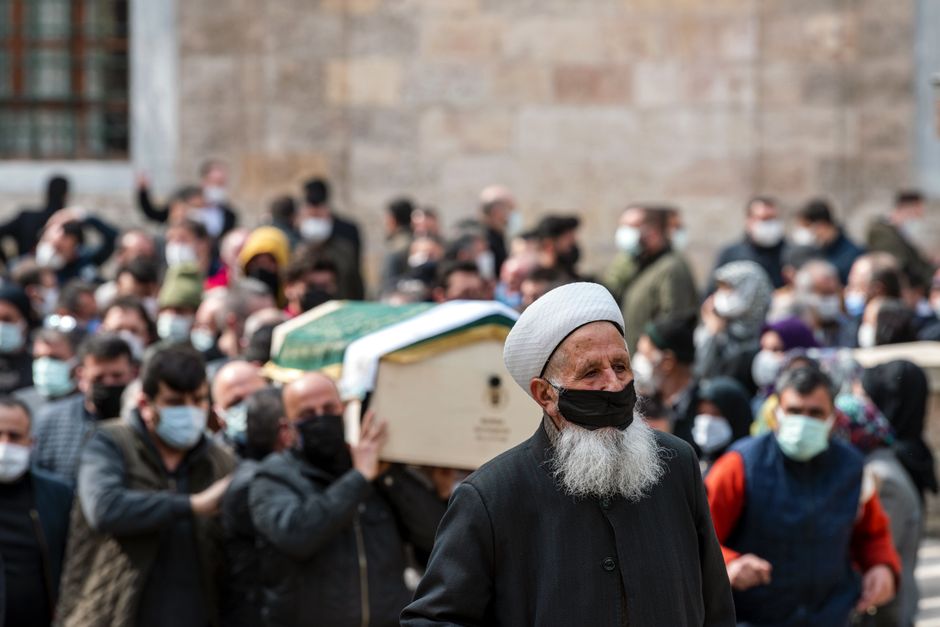
The body of slain Iranian Supreme Leader Ayatollah Ali Khamenei has been carried through vast crowds to his final resting place at one of Shi'ite Islam's holiest sites, as mourners chanted death threats against US President Donald Trump and fresh hostilities between Washington and Tehran erupted despite a recent truce.
Khamenei's coffin made its way by truck through the packed streets of Mashhad in northeastern Iran, flanked by white-turbaned clerics and followed by tens of thousands of black-clad mourners waving Iranian flags, photographs of the late leader and red placards bearing revolutionary slogans. When the sheer density of the crowd made it impossible for the vehicle to proceed further, a helicopter lifted the coffin the remaining short distance to the State funeral of Ali Khamenei's designated site — the gilded domes and minarets of the Shrine of Imam Reza.
The coffin was then laid on a carpet as senior clerics gathered to pray. As dusk fell over the shrine's courtyard, a sea of mourners filled every available space, their chants of "Death to America" rising above sorrowful string music and funeral laments broadcast over loudspeakers. Women held placards reading "Kill Trump," and crowds shouted: "I swear by the blood of the supreme leader, Trump, we will kill you!"
A Week of Mourning Reaches Its Climax
The burial in Mashhad marked the culmination of a week-long series of funeral events held across Iran following the February 28 strike that killed Ali Khamenei. Iranian authorities have pointed to the enormous turnout as proof of enduring popular support for the theocratic state, nearly five decades after the 1979 Islamic Revolution.
Senior ayatollahs attended the ceremony, seated on a raised dais beneath the intricate blue tiling of the shrine's arched architecture, as the nation mourned in scenes of intense, often volatile, grief.
Yet beneath the surface of national mourning, Iran faces deep internal pressures. Khamenei's 37-year rule left a bitterly contested legacy in a country where large numbers of citizens have repeatedly taken to the streets in recent years to protest poverty and political repression. How the country navigates its next chapter remains deeply uncertain.
New Supreme Leader Remains Out of Sight
Adding to that uncertainty is the conspicuous absence of Khamenei's son and successor, Mojtaba Khamenei, who was proclaimed Supreme Leader by a clerical assembly in early March — roughly one week after his father's death — but has not been seen in public since.
Mojtaba was reportedly badly wounded in the same strike that killed his father, suffering severe facial disfigurement and serious injuries to his limbs. While he has issued written statements, no photograph, video footage or voice recording of him has been released publicly.
Senior sources in Tehran have indicated he is recovering but has not yet been well enough to make any public appearances. It is also understood that state security services are actively working to limit his exposure, fearing further attacks from the United States.
US-Iran Hostilities Flare Again
The funeral took place against a backdrop of renewed military tension between Washington and Tehran. Despite a ceasefire agreement having been in place, US President Donald Trump declared this week that the truce was "over," and fresh exchanges of attacks followed.
Iran continues to control the strategically critical Strait of Hormuz, the narrow waterway through which a significant portion of the world's oil supply passes. Tehran has proclaimed that its survival of a sustained assault by both the United States and Israel constitutes a form of victory — a narrative being reinforced by the massive public show of mourning for Khamenei.
Analysts have warned that renewed confrontation in the region risks placing serious stress on global shipping and energy supplies at a time of already fragile economic conditions. For background on the ceasefire arrangement that has now broken down, see our earlier coverage of the Trump-Iran ceasefire and the Strait of Hormuz, as well as the renewed threat of US strikes over Iran's peace plan.
Iran Claims Legitimacy Amid Internal Fractures
Iranian authorities have been at pains to present the massive funeral gatherings as a powerful endorsement of their system of government — a deliberate messaging effort aimed at both domestic audiences and the watching world. The scale of the procession in Mashhad, and the fervour of the crowds, offered the regime potent imagery to project strength and continuity.
However, the invisible new Supreme Leader, the ongoing military pressure from the United States and Israel, and longstanding domestic discontent over economic hardship and political repression all point to a nation navigating one of the most turbulent transitions in its post-revolutionary history.
For now, Iran's clerical establishment is burying its founding ideological figurehead with full revolutionary ceremony — while the country's future leadership remains hidden from view, and its most powerful adversary shows no sign of standing down.