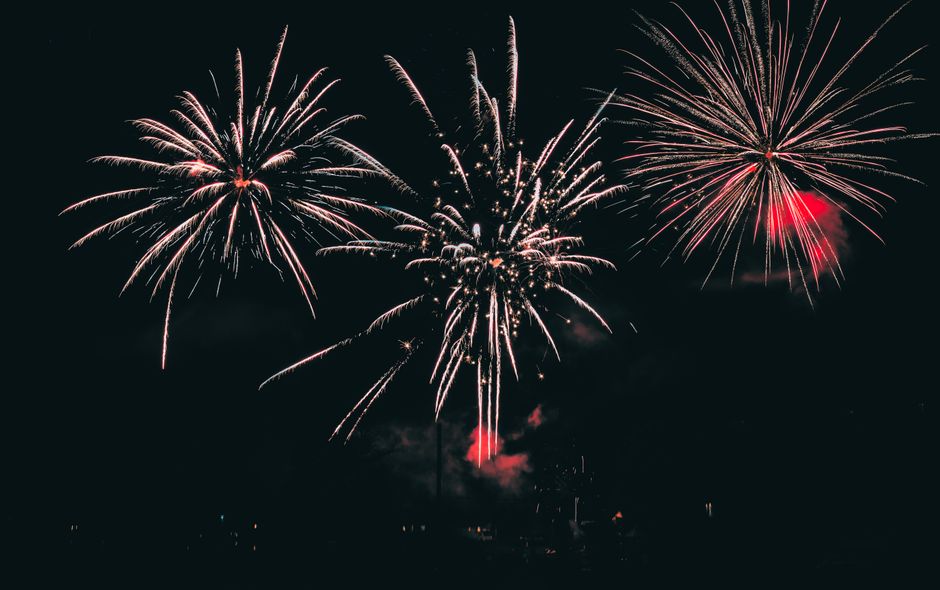
Every night during the Royal Queensland Show, as tired families settle into the grandstands and stake out spots on Machinery Hill, a small team of explosives professionals is quietly racing the clock. At precisely 7.45pm, months of meticulous preparation explode into a 40-minute spectacular marking Ekka's 150th anniversary — one of the most technically complex fireworks productions in Queensland.
For Skylighter Fireworks manager Nick Kozij and show designer Harrison Smith, the work to deliver that moment began as far back as March.
From Napkins to Nighttime Spectacle
The creative process is deceptively informal at first. Early ideas were sketched out on napkins, videos and screenshots were swapped, and the soundtrack and artistic concept gradually took shape over weeks of discussion. By the time opening night arrived, those rough ideas had been refined into a production designed to hold audience attention from the first beat to the final burst.
Smith's connection to fireworks runs deep. He grew up attending agricultural shows and at 18 signed on with the fireworks company that had always lit up his local event. Sixteen years later, he is the one designing the displays. Kozij's route was less straightforward — he came from the events industry, setting up large festivals, before organising a surprise fireworks display for his own wedding led to a chance meeting with the company's owner. One thing led to another, and a new career began.
He had hoped the move would mean more manageable hours. It did not quite turn out that way. "I was supposed to be in the office 40 hours a week and I don't think I've ever done a 40-hour week at this place ever, because it's all after hours," Kozij said. His mother, he noted, has always called him "a showman, a bit of a clown" — someone who simply likes to entertain people.
The Unique Challenge of a 360-Degree Arena
What sets the Ekka fireworks apart from a standard public display is the arena itself. Unlike most fireworks venues where the audience watches from one direction, the Ekka showgrounds place spectators completely surrounding the firing zone. Every single effect must be precisely measured, tested and contained within the arena boundary — nothing can stray beyond it.
"The big challenge, yeah, it's the round arena. Everyone's all around," Kozij explained. "I designed the show to make sure that everyone gets a good show … but also it all stays well within the confines of the arena."
Among the show's most photographed moments is a sequence involving 10 kites towed into darkness behind a quad bike before suddenly bursting into action — a crowd favourite that requires both precision driving and split-second timing.
For a broader look at the logistics behind the event as a whole, the massive scale behind the Royal Queensland Show's 150th celebrations offers further context on just how large an undertaking Ekka has become.
Weather, Wind and a Hospital Helipad
Mother Nature adds another layer of complexity every single night. The crew monitors wind speed, gusts, rainfall and lightning before each show. Brisbane's famous "Ekka winds" — the cold, blustery westerlies that descend on the city each August — are a particular concern, as they can shift direction rapidly and without warning.
Heavy rain can make the dirt arena track dangerously slippery for the motorbikes and quad bikes used in the production. If conditions deteriorate enough to rule out those elements, the crew can remove them from the running order while keeping the fireworks display itself intact.
Safety checks also include flight radar monitoring, because the Royal Brisbane and Women's Hospital helipad sits just 250 metres away from the showgrounds — a reminder that in a built-up urban environment, every decision carries real consequence.
When everything aligns — the weather, the crew, the music and the machines — the result is a spectacle that has become one of Brisbane's most anticipated annual traditions, now celebrating a milestone one and a half centuries in the making.