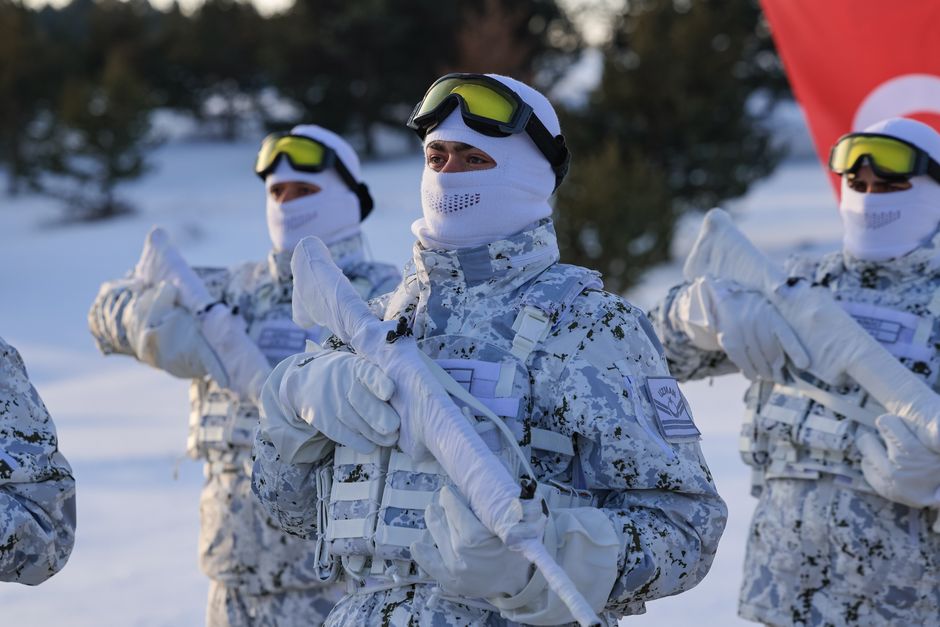
For the first time in recent history, Denmark has deployed conscripted soldiers to Greenland, marking a significant shift in the country's approach to Arctic defence as US President Donald Trump continues to push for American acquisition of the semi-autonomous territory.
The conscripts — part of the first cohort under Denmark's new extended conscription programme — are currently training north of the Arctic Circle, moving through a stark landscape of bare rock and open expanses as they prepare for operations in one of the kingdom's most strategically demanding environments.
Why Denmark is reinforcing its presence in Greenland
Trump has repeatedly sought to bring Greenland under American control, citing national security concerns and accusing Denmark of neglecting its responsibilities in the region. Both Denmark and Greenland have firmly rejected any suggestion of a transfer of sovereignty.
In response, Denmark has pledged billions of dollars to strengthen Arctic defences — an acknowledgement, according to the country's own defence minister, of years of underinvestment in the region. The deployment of conscripts is one of the most visible expressions of that renewed commitment.
"It shows presence that we're here and not just thinking of our own skin. And also thinking of the people in Greenland," said David, a 19-year-old conscript taking part in the exercise.
Fellow conscript Anton, 22, struck a broader strategic note: "I think it sends a message that Denmark is reinforcing itself for the future."
Arctic Endurance and the NATO mission behind the drills
The conscripts are participating in Arctic Endurance, a Danish military exercise designed to train soldiers for combat and survival in extreme cold-weather conditions. The exercise forms part of Arctic Sentry, a NATO mission launched this year with the specific aim of strengthening the alliance's Arctic presence and easing internal tensions that arose following Trump's remarks about Greenland.
Company commander Captain Laura Jepsen was measured about the mission's dual purpose. "Of course, we are a part of a bigger picture of the strategic communication about Greenland, but our role here is just to continue the training of the conscripts, the soldiers, and get more experience with the training in the Arctic terrain and climate," she said.
The exercises reflect a broader NATO recalibration in a region that has grown increasingly contested. Russia maintains the Arctic's largest military footprint of any nation and has criticised the alliance's growing activity there, describing it as a direct security threat that raises the risk of armed confrontation. China has also expanded its presence in the mineral-rich region, largely in partnership with Russia.
A region at the centre of great power competition
Greenland's strategic significance extends well beyond its geography. The island sits astride critical shipping lanes and is believed to hold vast untapped mineral reserves, making it a focal point not just for the United States but for multiple global powers with competing interests in the far north.
Denmark's decision to send conscripts — rather than only professional troops — underscores how seriously Copenhagen is treating the territory's long-term security. The extended conscription programme is explicitly designed to build a generation of soldiers capable of operating in Arctic conditions, signalling that Denmark views its commitment to Greenland as an enduring military and strategic priority, not simply a short-term response to political pressure from Washington.
Trump's interventionist tendencies across a range of international affairs have drawn sustained global attention. His administration's approach to security alliances and territorial ambitions has reshaped diplomatic calculations in multiple regions simultaneously.
For now, Denmark's message through its conscript deployment appears deliberate and clear: that Greenland's defence is a Danish responsibility, and one the country intends to take seriously on the ground — regardless of what is demanded from across the Atlantic.