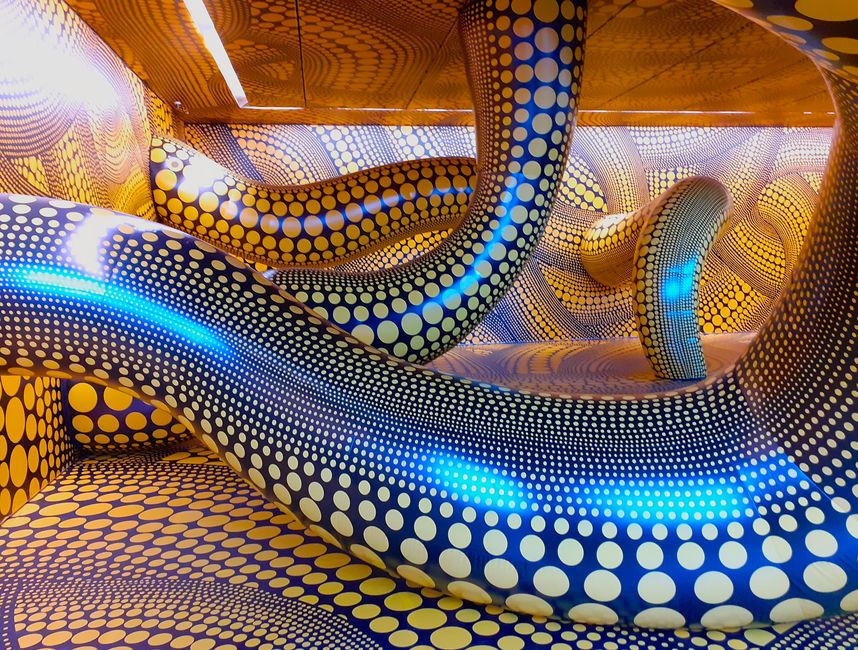
Yayoi Kusama, the Japanese artist celebrated worldwide for her polka dot paintings, dotted pumpkin sculptures and immersive mirror rooms, has died in hospital in Tokyo at the age of 97. Her passing marks the end of a career spanning more than eight decades — one defined by extraordinary creative output, commercial triumph and a lifelong struggle with mental illness.
A mind shaped by hallucinations and hardship
Born in 1929 as the youngest daughter of a wealthy but troubled family in Matsumoto, central Japan, Kusama began producing her now-iconic dot and net patterns from the age of 10. Her early life was far from stable. She later wrote in her autobiography, A Personal History of Polka Dots, that her mother harboured regrets about her birth, leaving her feeling psychologically pushed to the edge.
Kusama experienced vivid hallucinations from childhood — on one occasion seeing a red flower pattern from a tablecloth spread across every surface in the room, including her own body. Rather than retreating from these visions, she channelled them into art. "When I was sad or lonely, everything would be cured when I drew pictures," she once said.
This compulsion gave rise to one of her most enduring philosophical concepts: "self-obliteration." By repeating patterns obsessively across canvases, sculptures and even her own body, Kusama sought to dissolve the boundaries of individual identity. "By creating the same thing over and over, my own existence is buried in the art," she explained.
The connection between creativity and solitude was something Kusama returned to often — a thread that ran through both her personal suffering and her artistic vision, and one that resonates with broader conversations about the mental health of creative professionals.
From poverty in New York to global icon
Kusama studied traditional Japanese painting in Kyoto — against her parents' wishes — and held her first solo exhibition in 1952. It was there she met a psychiatrist who urged her to seek opportunities abroad. The advice aligned with her own restlessness. She described Japan as "so small, vulgar, feudalistic and full of disdain for women," and began looking outward.
A letter she wrote to modernist painter Georgia O'Keeffe proved pivotal: O'Keeffe encouraged her to pursue recognition in the United States. Kusama moved to Seattle in 1957 before settling in New York, where she spent 16 years navigating a creative scene that was largely white and male-dominated. The early years were punishing. She later recalled going three days without food and surviving on breadcrumbs left by pigeons.
She persisted, and by the 1960s had become a prominent force in New York's avant-garde world. At the height of the sexual liberation movement, she staged public "happenings" in which participants stripped naked in locations such as Wall Street and Central Park and had polka dots painted on their bodies. She launched a fashion line, established a so-called "Church of Self-Obliteration" and officiated at a gay wedding, styling herself the "High Priestess of Polka Dots."
A voluntary life inside a psychiatric hospital
By the time Kusama returned to Japan in 1973, she was burnt out. She voluntarily checked herself into a psychiatric hospital in Tokyo, where she would live for the remainder of her life. Far from retreating into obscurity, she continued to work prolifically from her studio near the facility, becoming increasingly recognised as a global art world phenomenon in her later decades.
Instantly identifiable in her bright red wig and boldly spotted clothing, Kusama's large-scale paintings, sculptures and mirror installations sold for millions of dollars and drew enormous crowds at leading galleries around the world. Her complex feelings about Japan — a country she had fled but ultimately returned to — never fully resolved.
She is remembered not only as one of the most commercially successful artists of her era, but as a figure whose work transformed personal anguish into universal wonder.