China dispatched at least four advanced surveillance ships across the Pacific Ocean in the days before it test-fired a nuclear-capable ballistic missile from a submarine on Monday, with vessel-tracking data revealing the vessels were pre-positioned around the likely target zone — an area of ocean near Tuvalu and Nauru, close to where many Australians take their holidays.
The missile test, which Beijing described as a "routine arrangement" under its annual military training schedule, has drawn sharp criticism from Pacific nations, Australia, New Zealand and the United States, and raised urgent questions about Australia's capacity to defend itself against long-range missile threats. For more on the regional response, see our earlier coverage of China's nuclear missile test in the Pacific and the alarm it triggered across the region.
Four Chinese Spy Ships Fanned Out Across the Pacific
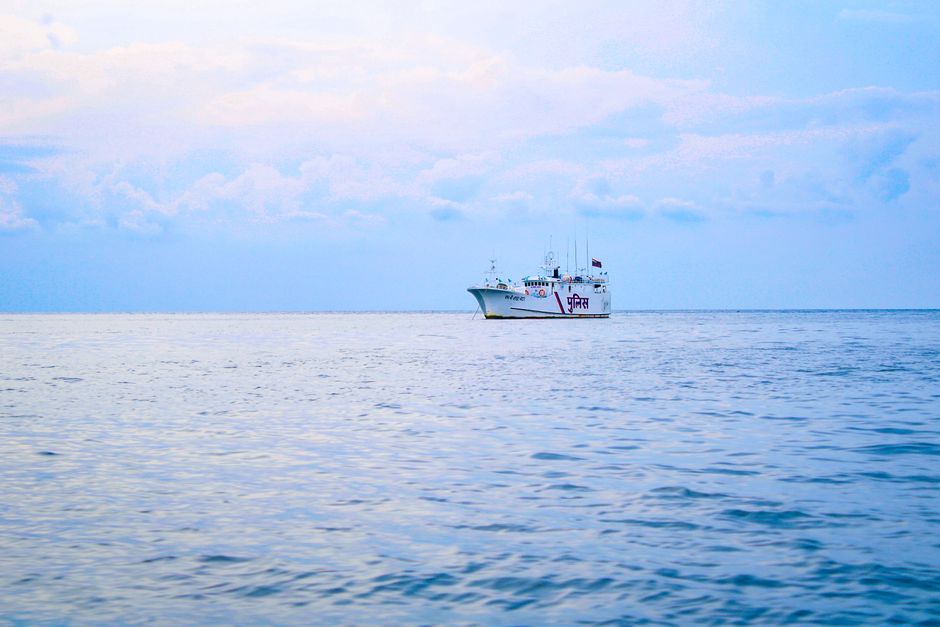
Commercially produced maritime tracking data reveals a coordinated deployment of Chinese scientific research and satellite-tracking vessels in the lead-up to the launch. Each ship was strategically positioned to monitor different phases of the weapon's flight and collect telemetry data.
- Yuan Wang 5 — berthed in Fiji's capital, Suva, in early July, just days before Prime Minister Anthony Albanese arrived in the city to sign a defence treaty with the Pacific nation.
- Yuan Wang 3 — tracked operating in international waters off the Philippines, used for surveillance and communication related to intercontinental ballistic missiles.
- Yuan Wang 6 — recorded near the Federated States of Micronesia at the same time.
- Liao Wang 1 — China's newest spy ship, designed to monitor military satellites and track missile launches, operating in waters north-east of the Solomon Islands.
The People's Liberation Army Navy published images of the test but withheld specifics about the type of submarine or missile involved, the precise launch and impact locations, and the total distance the warhead travelled.
Warhead Came Down Near Tuvalu and Nauru, Taiwan Says
Chinese Navy spokesman Senior Captain Wang Xuemeng confirmed the warhead "precisely hit the designated target waters in the Pacific Ocean", but declined to specify exactly where it landed. He maintained that the test "complied with international law and established international practices" and was "not targeted at any specific country or target", adding that Beijing had provided prior notification to relevant countries.
A clearer picture of the missile's trajectory emerged late Monday when the head of Taiwan's national security council, Joseph Wu, published a map showing the apparent flight path of the submarine-launched ballistic missile. According to the map, the weapon — identified as a JL-2 — flew over the Philippines before its warhead struck waters roughly 800 to 1,000 kilometres north-east of the Solomon Islands, near Tuvalu and Nauru.
"It's a provocation that destabilises the Indo-Pacific. China just proved itself again to be a bully on the block," Mr Wu wrote alongside the image.
According to Chinese state media, the last time Beijing publicly acknowledged the flight test of a submarine-launched ballistic missile was in September 1988, when a Type 09II submarine launched two JL-1 missiles from the Bohai Sea — making Monday's announcement a rare public disclosure of such activity. Our analysis of China's submarine-launched missile test and what it means for Australia and its Pacific neighbours examines the broader strategic context.
Australia's Missile Defence Response
The timing of the Chinese missile test has thrown a sharp spotlight on Australia's own defence preparedness. Days after the launch, the Australian Defence Force released details and footage of a prototype missile defence system it had test-fired in June at the Woomera testing range in South Australia.
The trial, conducted jointly with the United States under Exercise Taipan Strike 2026, involved firing a Standard Missile-2 — a weapon with a range of up to 166 kilometres currently used by the Royal Australian Navy — from an American-supplied Derringer trailer-mounted Expeditionary Launch System. An Australian radar guided the interceptor to successfully destroy an airborne cruise missile target drone.
Defence Minister Richard Marles described the test as a significant step forward. "This first of type live-fire test is a practical demonstration of how the Australian Defence Force is working with its partners and local industry to deliver crucial defence capabilities, growing our sovereignty and helping to keep Australians safe," he said.
The ADF expects to spend between $7 billion and $10 billion over the next decade on missile defence infrastructure across the country, with a medium-range ground-based air defence system flagged as an urgent priority in the government's 2026 Integrated Investment Plan. Key acquisition decisions are expected later this year.
Air Marshal Stephen Chappell, chief of the Air Force, described the Woomera exercise as central to informing those procurement choices. The federal opposition, meanwhile, has questioned whether the pace of capability development is fast enough given the threat environment now on vivid display in the South Pacific.
A Wake-Up Call Close to Home
Former soldier and defence commentator Steve Baxter put the geographical reality in blunt terms. "It came down west of the Solomon Islands. Not the Taiwan Strait. Not the South China Sea. Near where many of us go on holidays," he said, arguing Australia is not spending nearly enough on defence and that the government needs to have frank public conversations about the threat.
The test — and the elaborate network of surveillance ships deployed to support it — underscores the extent to which Beijing is advancing its long-range strike capabilities in waters that Australians and their Pacific neighbours regard as their own backyard. The strategic reckoning demanded by China's Pacific missile test is now firmly on Canberra's agenda.