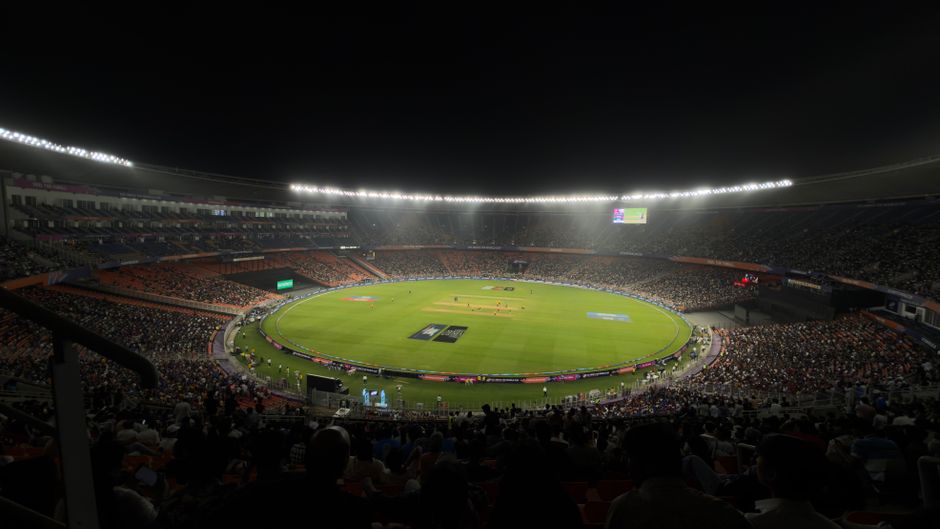
Indian Prime Minister Narendra Modi addressed a crowd of around 20,000 people at Melbourne's Marvel Stadium on Thursday evening, delivering a warm and colourful tribute to the Indian diaspora's place in Australian life during what he described as a historic hat-trick visit to the country.
The event, billed as "Melbourne Meets Modi", formed a centrepiece of Modi's three-day trip to Australia for the Australia-India Annual Leaders' Summit. Australian Prime Minister Anthony Albanese and Victorian Premier Jacinta Allan joined him on stage, both receiving levels of applause rarely experienced at events of a political nature.
Chai wallahs and cricket players: Modi's address captures the crowd
Taking to a purple-garlanded stage to the roar of thousands waving mobile phone lights, Modi used vivid domestic imagery to describe the relationship between the two nations and the contribution of Indians living in Australia.
"The milk at home might be Australian, but the tea brewed is Indian," he told the crowd to sustained applause. "The lentils and vegetables are Australian, yet they are tempered with authentic Indian spices."
Returning to the tea metaphor — a nod to his oft-cited origins as a chai wallah, or tea vendor — Modi declared: "Just as sugar is added to milk and makes it sweeter, we Indians infuse the world." The crowd responded with a roar of approval.
Modi also marked the significance of the visit in personal terms. "In the last 12 years, I have come here for the third time. This time, a hat-trick has been scored," he said. "This reflects the heights that India-Australia relations have reached."
Employing the English-language catchphrase "Grow more! Achieve more!", Modi outlined his ambition for India to become one of the world's top three global economies, pointing to rapid digital transformation and the country's 5G rollout as indicators of the nation's trajectory. "The India of the 21st century is working towards becoming a developed nation. When we realise one dream, new dreams take its place," he said.
Albanese and Allan join the celebration
Albanese, who told the crowd he first visited India as a backpacker in 1991, used the occasion to praise the Indian-Australian community's role in shaping the nation. "We're a better nation because we have you in it," he said. "You are the living bridge between Australia and India."
Premier Allan, who revealed she has maintained a 600-day yoga streak since visiting India as premier in 2024, joined in the celebration of the two countries' deepening cultural ties.
Outside Gate 2 of the stadium, the 50-strong Cranbourne drumming group Janagar Jana Dhol Pathak provided a thundering welcome for the arriving crowd, with massive dhol drums carried over the shoulder alongside smaller tasha drums. "This is a very important event for us," said drumming leader Satish Gaikwad. "Australia and India coming together. That's the unity we want to show the world."
A growing diaspora — and a divided response
The evening was not without dissent. A group of protesters, including supporters of the Khalistan movement — which broadly advocates for a separate Sikh homeland and has faced suppression by the Indian government — gathered outside Government House earlier on Thursday. A smaller contingent of around 30 protesters bearing "Modi Go Home" signs was present near the stadium, though their presence was largely eclipsed by the tens of thousands streaming inside.
Attendee Rachita Savant from Wyndham Vale said she understood the protesters' emotions but questioned their understanding of the communities involved. Her friend Gayatri Gangapurkar of Truganina drew a parallel between Indian and Australian multiculturalism. "Australia accepts diversity and India is the same," she said. "It is one India, but there are different cultures, different languages living together."
The scale of Thursday's event reflects a broader demographic shift. Thirty years ago, the Indian diaspora in Australia numbered around 50,000 people. When the next census data is released, it is expected to show that figure has grown to approximately 1.3 million — surpassing the British-born population to become the largest foreign-born group in the country, according to media industry figures tracking the community.
The Canberra India Council's Deepak-Raj Gupta, who travelled to Melbourne specifically to attend as many Modi-related events as possible, offered a straightforward explanation for the Indian leader's celebrity status. Modi belongs to a group of three types of figures who command adoration back home, he said: "Politicians, Bollywood stars and cricket players. It doesn't really matter who you are if you fall into one of those."
Strategic significance beyond the spectacle
University of Melbourne senior lecturer in Asian politics Pradeep Taneja described the visit as both "significant" and "unprecedented". "No other Indian prime minister has been to Australia three times during his term in office," he said, noting that the security relationship between the two nations has deepened considerably in recent years.
"Australia now regards India as a top-tier security partner," Taneja said, using language he attributed directly to the Australian government. The bilateral relationship, set against the broader history of India's post-independence development as a global power, has accelerated markedly since Modi first visited Australia in 2014.
Modi's Melbourne address was the cultural high point of a visit that has also included a business conference and bilateral talks focused on deepening trade and defence ties — a relationship that, as Thursday night demonstrated, carries considerable weight well beyond the corridors of government.