Australian HYROX world-record holder Joanna Wietrzyk has issued a formal apology and voluntarily forfeited her race victory after footage of her competing with faecal matter visibly on her body during a Beijing event went viral, sparking international controversy and prompting the sport's governing body to rewrite its rulebook.
Wietrzyk, 22, from Melbourne, won the women's Pro race at the Beijing HYROX event on Saturday in a time of 1:01:23 — but the circumstances of that win quickly overshadowed the result. Images and video showing her competing across shared exercise stations with faeces smeared across her arms and legs spread rapidly across social media, generating global debate about athlete welfare, hygiene standards and race officiating.
Wietrzyk's apology and decision to forfeit
In a statement posted to Instagram on Thursday night — nearly a week after the incident — Wietrzyk offered an unreserved apology to multiple parties.
"I want to offer my sincere apology to the people of China, my fellow competitors, the spectators and the HYROX organisers for what happened during the race in Beijing," she wrote.
She acknowledged that, with hindsight, she should have stepped off the course. "Looking back, I regret the decision to not have stepped off the track. I recognise that I should have made a different choice. I take responsibility for my decision to continue and am deeply sorry for the discomfort and disruption it caused."
Wietrzyk announced she would retroactively withdraw from the race and forfeit all points earned from the win. "I am learning from this experience and will carry those lessons with me, including remembering that there is more to life than racing and knowing when it is right to step away," she said.
She also thanked supporters who had stood by her through the fallout, saying their kindness "means more to me than I can properly express right now," and indicated she would be taking time away from competition to recover and look after herself and her family.
Wietrzyk had initially shared a selfie from what appeared to be a hospital bed — showing an intravenous line in her arm — shortly after the race, captioning it: "Go hard or go home they say … a win is a win." That post was later deleted.
HYROX responds and changes its rulebook
The incident has also forced HYROX's leadership into damage-control mode. Co-founder Moritz Fürste issued a public apology earlier in the week, acknowledging the organisation had failed to act swiftly enough during the race.
"HYROX made a mistake by not reacting immediately to the incident," Fürste said. "In the end it is my job to foresee these potential incidents — and I did not."
He apologised to those "directly or indirectly" affected, as well as to anyone who felt the situation was not handled appropriately. Following the controversy, HYROX formally updated its rulebook to allow officials to withdraw a competitor if their faeces pose a "contamination risk" to shared equipment or other athletes — a scenario the existing rules had not explicitly covered.
Critics had pointed out an apparent inconsistency in the sport's penalty framework, with reports indicating that athletes can be penalised for acts such as spitting, vomiting or mishandling water bottles, yet no provision existed to remove a competitor in Wietrzyk's situation.
Coach defends athlete — and his own tone
Wietrzyk's coach, Chris Bayens, found himself navigating a delicate line between defending his athlete and managing the broader public reaction. In an early post on Monday, he condemned what he described as "ugly" personal attacks directed at Wietrzyk, arguing that decisions made during the race — by the athlete, judges and officials alike — were made under fast-moving conditions that none of them could have reasonably anticipated.
"It is very easy to construct the perfect response once the moment has passed," Bayens wrote. "Hindsight gives people time, information and distance that simply did not exist for those actually living it."
He added: "Sport occasionally produces moments that are imperfect and deeply human. The hatred and personal attacks that have followed are not."
By Wednesday, Bayens had shifted to a slightly lighter register, posting on Instagram: "I had a few things on my bingo card for the 26-27 HYROX season. This was absolutely not one of them."
When a follower questioned whether the more humorous tone was appropriate given his earlier condemnation of the attacks, Bayens acknowledged it was a "fair question" but defended his approach. "It's more an attempt to take a slightly lighthearted view of what has been, frankly, an absurd few days personally and professionally," he replied. "I can absolutely condemn the personal attacks while still taking a lighter view of the wider circus that has developed around it."
Sponsorship questions and wider fallout
The controversy also raised questions about Wietrzyk's commercial relationships. It is understood that a collaborative product line between Wietrzyk and major sportswear brand Puma temporarily disappeared from the brand's website, fuelling speculation that the company was distancing itself from the athlete. The pages were subsequently restored, with a Puma spokesperson attributing their removal to some landing pages being "unintentionally taken offline."
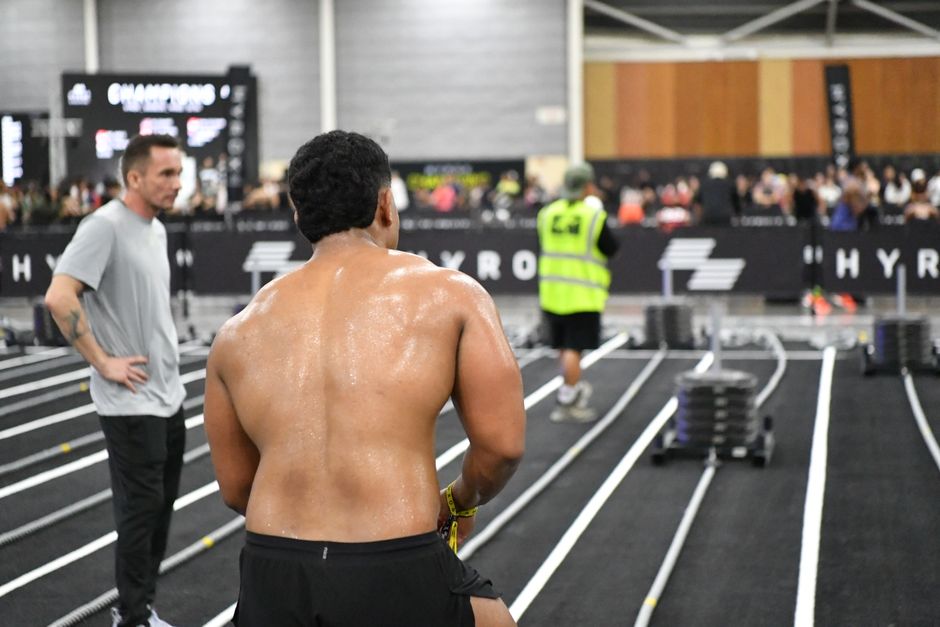
HYROX — a fitness and endurance format combining eight kilometres of running with exercises including rowing, sled pushes and wall balls, held in indoor exhibition venues — has grown rapidly in popularity in recent years, including in Australia. The Beijing incident is likely to prompt closer scrutiny of the sport's health and safety protocols as its global footprint continues to expand.